
The 2008 Wimbledon men’s singles final is widely regarded as one of the greatest matches ever played in tennis history. Featuring Rafael Nadal and Roger Federer at the peak of their powers, the contest delivered extraordinary drama, breathtaking quality, and immense significance. It was a match that stretched over nearly seven hours, interrupted by rain delays and ultimately concluded under fading light on Centre Court. In the end, it was Nadal who triumphed in a thrilling five-set battle, a victory that would prove pivotal in shaping his legendary career.
At the time, Nadal was just 22 years old and still striving to establish himself as a dominant force beyond clay courts. While he had already built a formidable reputation as the “King of Clay,” thanks to his dominance at Roland Garros, critics often questioned his ability to succeed on other surfaces, particularly grass. However, Nadal himself never doubted his versatility. He believed that to truly become a complete player, he needed to perform at the highest level across all surfaces.
Reflecting on that iconic Wimbledon triumph, Nadal later described it as one of the proudest moments of his career. Defeating Federer, widely considered the greatest grass-court player in history, in such a high-stakes final gave him immense confidence. Yet, true to his relentless mindset, Nadal did not allow himself to dwell on the achievement. Instead, he saw it as a stepping stone, motivating him to push further and continue improving.
Before his 2008 victory, Nadal had experienced heartbreak at Wimbledon. He had reached the final in both 2006 and 2007, only to be defeated by Federer on each occasion. Federer entered the 2008 tournament as the five-time defending champion, having not lost at Wimbledon since 2002. The Swiss maestro was widely expected to continue his dominance on grass, making Nadal’s challenge even more daunting.
However, Nadal entered Wimbledon 2008 in exceptional form. Just weeks earlier, he had delivered a crushing performance against Federer in the French Open final, winning in straight sets and dropping just four games. That victory provided Nadal with the belief that he could finally overcome his rival on grass.
The Wimbledon final itself lived up to all expectations and more. Nadal began strongly, showcasing his aggressive baseline play and improved movement on grass. He broke Federer early in the first set and maintained his advantage to take it 6-4. In the second set, Nadal demonstrated remarkable resilience, coming back from a 4-1 deficit to win five consecutive games and claim the set 6-4. At that point, he was just one set away from victory.
Federer, however, refused to surrender his crown easily. In the third set, he raised his level significantly, displaying his trademark precision and attacking flair. After saving multiple break points, Federer edged the set 7-6 in a tense tie-break. The momentum began to shift as the match intensified.
Rain interruptions added another layer of drama to the contest, halting play at crucial moments. Despite these disruptions, both players maintained their focus and continued to produce tennis of the highest quality. The fourth set was another epic battle, culminating in a dramatic tie-break. Nadal came agonizingly close to victory, holding championship points, but Federer’s resilience saw him prevail and force a deciding fifth set.
The psychological challenge for Nadal at that stage was immense. Having been so close to victory, only to see it slip away, he had to regroup mentally and prepare for a final push against one of the greatest players in the game. Yet, his determination and mental strength proved decisive.
The fifth set was a fitting conclusion to an extraordinary match. Both players held serve for much of the set, with neither willing to give an inch. As darkness began to fall over Centre Court, the tension reached its peak. Finally, at 7-7, Nadal managed to secure a crucial break of serve, putting himself in position to serve for the championship.
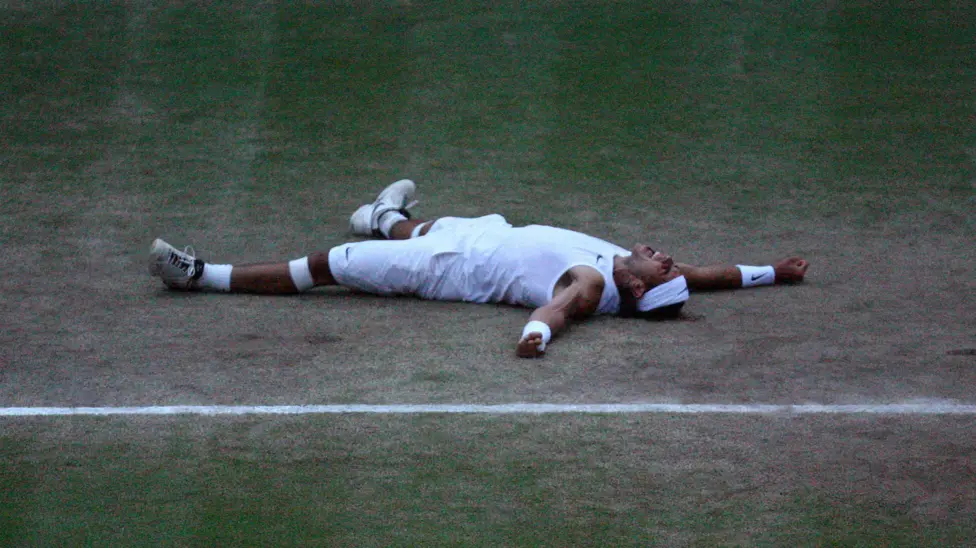
With the light fading and the crowd on edge, Nadal stepped up to serve for the title. Despite the immense pressure, he held his nerve and secured victory on his third championship point. Federer’s final shot found the net, and Nadal collapsed onto the grass in celebration, overwhelmed by the magnitude of his achievement.
The final scoreline read 6-4, 6-4, 6-7, 6-7, 9-7, reflecting the closely contested nature of the match. It was a contest that lasted four hours and 48 minutes of playing time, making it the longest Wimbledon final at that time. More importantly, it marked the end of Federer’s dominance at the tournament and the beginning of a new era.
Nadal’s victory had far-reaching implications for his career. It boosted his confidence and reinforced his belief that he could succeed on any surface. Shortly after, he would go on to become the world number one, further solidifying his status as one of the greatest players of all time.
In the years that followed, Nadal continued to achieve remarkable success. He won the Australian Open in 2009 and completed the career Grand Slam by winning the US Open in 2010. While he would go on to win Wimbledon again, it is the 2008 final that remains the most iconic moment of his career.
The match also holds a special place in tennis history as the last Wimbledon final played on Centre Court before the installation of a retractable roof. Its unique circumstances, combined with the extraordinary level of play, ensure that it will be remembered as a timeless classic.
For Nadal, the 2008 Wimbledon victory was more than just a title—it was a defining moment that proved his greatness beyond any doubt. It showcased his resilience, determination, and ability to rise to the occasion against the very best. Even today, it stands as one of the most emotional and significant matches of his illustrious career.