
England’s 4-2 victory over Croatia delivered plenty of excitement going forward, but it also exposed some concerns defensively. While fans enjoyed the attacking intent and fluid play, there were moments when England appeared vulnerable at the back. In football, attacking and defensive phases are deeply connected, meaning that how a team plays with the ball directly impacts how they defend without it. To fully understand England’s performance, it is essential to evaluate both aspects together.
This match presented a different version of England under Thomas Tuchel—one that was more adventurous and entertaining but slightly less secure defensively compared to previous games. The balance between risk and control seemed tilted towards attack, which created thrilling moments but also opened gaps for Croatia to exploit.
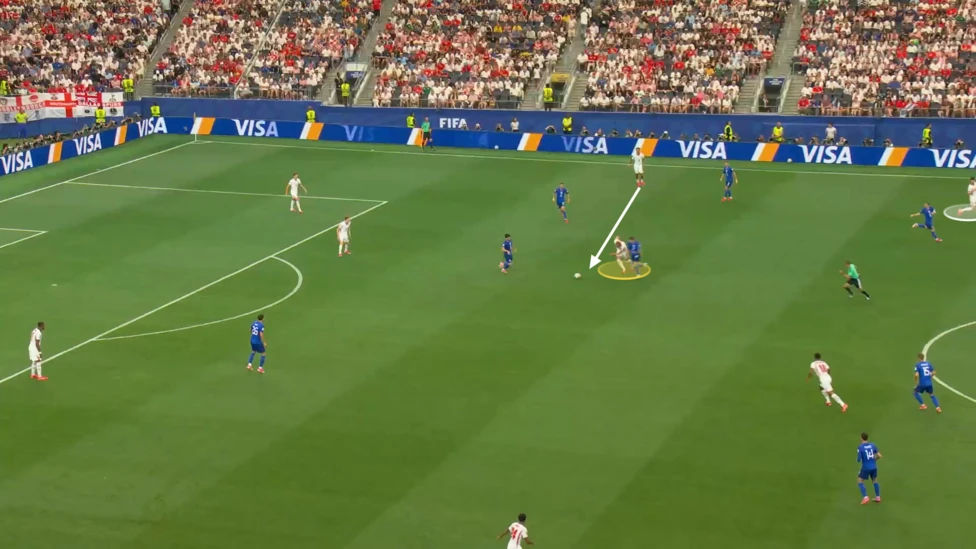
One of the key tactical patterns in the first half was England’s attempt to draw Croatia into pressing high up the pitch. They often circulated the ball backwards to tempt Croatian players forward. During this phase, Declan Rice frequently drifted into wider areas, leaving central midfield space vacant. This allowed Harry Kane to drop deeper into midfield, acting almost as a playmaker.
With Croatia committing players forward, Kane used his vision to play long passes into attacking runners such as Anthony Gordon, Jude Bellingham, and Noni Madueke. At times, this created dangerous three-on-three situations, giving England promising attacking opportunities. However, this approach came with a downside. When possession was lost, Kane was often positioned in central midfield areas instead of Rice, leaving England exposed defensively.
This positional imbalance was a major factor behind England’s defensive fragility. Losing the ball in build-up phases meant that key defensive areas were occupied by attacking players rather than natural midfield protectors. As a result, Croatia found spaces to counterattack more easily.
Another issue was England’s tendency to play too directly at times. While the strategy of mixing short and long passes can be effective, England occasionally misjudged when to do each. Assistant coach Anthony Barry highlighted this problem, noting that the team sometimes chose the wrong option—going long when short passes were needed and vice versa.
Because of this inconsistency, England conceded possession more frequently than desired. These turnovers contributed to an open, end-to-end style of play, which increased the chances for both teams but reduced England’s overall control of the match.
Croatia also applied intelligent pressing, particularly targeting goalkeeper Jordan Pickford. By using him as a trigger, Croatian attackers forced him into hurried long clearances. This often resulted in England losing possession quickly, handing momentum back to the opposition. Such pressing disrupted England’s rhythm and prevented them from building attacks in a controlled manner.
Off the ball, England’s pressing structure also created challenges. In the first half, the front three—Gordon, Kane, and Madueke—pressed Croatia’s defensive line aggressively. However, when the ball was played to Croatia’s wing-backs, England’s wide defenders had to cover significant distances to apply pressure. This delay allowed Croatia to progress the ball up the pitch with relative ease.
The issue was not just about distance but also about coordination. When players are required to press over large areas, the defensive shape can become stretched, leaving gaps between units. Croatia capitalized on these spaces, especially during transitions.
Another tactical concern emerged when England dropped deeper into a defensive block. The team struggled to shift from a man-oriented pressing system to a more zonal defensive approach. Players often followed their direct opponents instead of maintaining positional discipline.
This confusion was evident in the build-up to Croatia’s second goal. Harry Kane tracked Luka Modric into midfield, leaving his usual position up front. At the same time, Madueke drifted centrally, and Bellingham moved wide to compensate. These positional changes resulted in players occupying unfamiliar roles, weakening England’s defensive structure.
Throughout the game, England occasionally transitioned from a back four to a back five, with either Rice or Elliot Anderson dropping into the defensive line. While this adjustment was intended to match Croatia’s attacking numbers, it sometimes created gaps in midfield. On certain occasions, these spaces could have been exploited more effectively by Croatia.
For Croatia’s second goal, England’s defensive organization broke down due to individual movements. Martin Baturina dropped deep, drawing both Anderson and Bellingham out of position. This movement disrupted England’s defensive line, creating a gap between Reece James and Ezri Konsa. With no pressure on the ball, Croatia delivered a precise pass into that space, allowing Ivan Perisic to set up Petar Musa’s goal.
Despite these issues, England showed signs of improvement in the second half. Instead of pressing across the entire Croatian back line, they adjusted their approach by angling their press. This forced Croatia to play towards one side of the pitch, making it easier for England to apply coordinated pressure.
Harry Kane played a key role in this adjustment, positioning his body to block passing lanes and guide the opposition into predictable areas. This tactical tweak allowed England to press more effectively without overextending themselves.
Overall, while there is still room for improvement, there were encouraging signs for England. Their attacking play was dynamic and created numerous chances, which will be a positive takeaway. However, to succeed against stronger opponents, they must find a better balance between attack and defense.
Maintaining control of possession will be crucial. If England can dominate the ball and dictate the tempo of matches, they will reduce the time spent defending in dangerous areas. Improving their defensive organization, particularly when transitioning between pressing and deeper blocks, will also be essential.
In conclusion, England’s performance against Croatia highlighted both their strengths and weaknesses. The attacking intent made for an exciting spectacle, but the defensive vulnerabilities cannot be ignored. With better decision-making, improved positional discipline, and more cohesive pressing, England have the potential to become a more complete and formidable team as the tournament progresses.