

Two matches, two dramatic stoppage-time interventions by the Video Assistant Referee (VAR), and two decisions that could have a major influence on title races. These incidents, occurring in both England and Scotland, have once again reignited debate about VAR’s role in modern football and whether it truly improves the game.
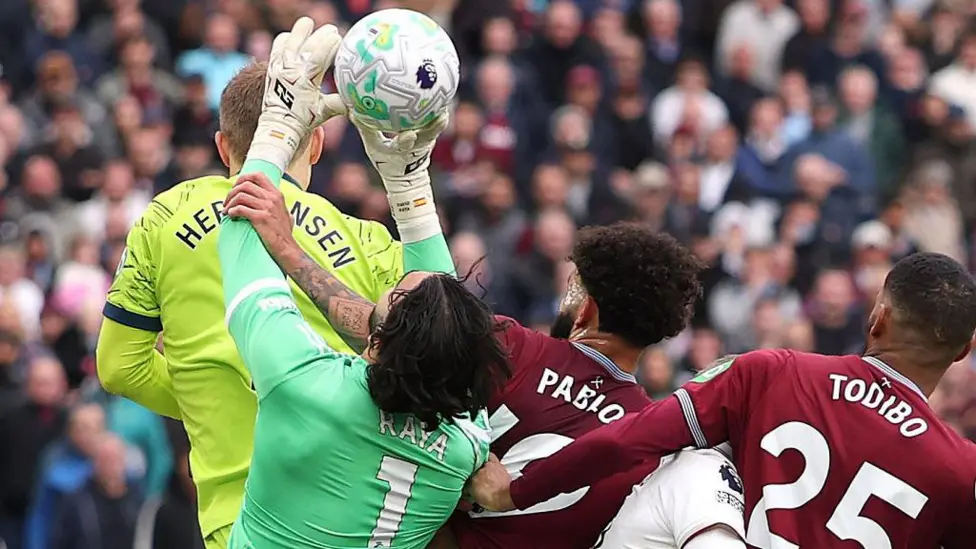
On Sunday in the Premier League, West Ham thought they had scored a crucial equaliser against Arsenal. However, their goal was ruled out after VAR determined that there had been a foul by Pablo on Arsenal goalkeeper David Raya in the build-up. This decision ensured Arsenal secured a 1-0 victory, keeping their title ambitions firmly in their own control while leaving West Ham deeper in relegation trouble.
Just a few days later, in the Scottish Premiership, another controversial VAR moment unfolded. In a match between Celtic and Motherwell, a handball was awarded against Sam Nicholson in the final seconds of stoppage time. The decision came after VAR intervention, with only seconds remaining on the clock. Celtic’s Kelechi Iheanacho converted the resulting penalty, sealing a dramatic 3-2 victory with what was effectively the last kick of the game.
Both incidents sparked intense reactions from fans, pundits, and the media. In each case, the decision favored a larger club competing for the title, which led to accusations of bias and dissatisfaction among neutral supporters. However, despite the similarities, there were also significant differences in how the decisions were reached and perceived.
Former Liverpool midfielder Danny Murphy suggested that some of the backlash against the decision in Arsenal’s favor may stem from a general reluctance among neutral fans to see Arsenal win the title. He argued that perceptions about Arsenal’s playing style, particularly their effectiveness from set-pieces and physical presence during corners, might influence opinions. Murphy emphasized that decisions should be judged independently rather than being colored by past grievances or biases against a particular team.
In Scotland, the situation is somewhat different. Many fans outside the traditional “Old Firm” clubs—Celtic and Rangers—would prefer to see a different champion, such as Hearts, breaking the long-standing dominance of these two teams. Not since Aberdeen’s triumph in the 1984-85 season under Sir Alex Ferguson has another club won the Scottish league title.
The late penalty awarded to Celtic significantly impacted the title race. Instead of needing a large-margin victory in their upcoming decisive match against Hearts, Celtic now only require a simple win to secure the championship. This shift has heightened the stakes and added further controversy to the decision.
These incidents raise broader questions about whether VAR is truly benefiting football. When it was introduced, many believed it would eliminate disputes over refereeing decisions by providing clear and definitive answers. However, the reality has been quite different. Instead of reducing controversy, VAR has often intensified it, as fans now scrutinize both the on-field referee and the video officials.
It is important to remember, though, that disputes over refereeing decisions existed long before VAR. The introduction of video technology was a response to widespread frustration with human errors in officiating. Without VAR, controversial moments would still occur, and debates would likely continue.
In the case of the West Ham goal, most pundits and refereeing experts agreed that the decision to disallow it was correct. The image of Pablo holding onto Raya’s arm provided sufficient evidence of a foul. However, many fans disagreed, illustrating the divide between expert analysis and supporter sentiment.
In contrast, the consensus in Scotland has been largely against the VAR decision to award Celtic’s penalty. Critics argue that the evidence was not conclusive enough to justify overturning the on-field decision. Hearts manager Derek McInnes even described the call as “disgusting,” highlighting the level of frustration among those opposing the decision.
One of the key differences between the two incidents lies in the process of reviewing the decisions. In the Arsenal match, the VAR team took over four minutes to analyze multiple angles and incidents. The referee reviewed numerous replays before reaching a conclusion, reflecting a thorough and detailed approach.
In the Celtic match, however, the review process was much quicker. The VAR check lasted just over a minute, and the referee spent only 20 seconds at the pitchside monitor, viewing limited replays. This difference in approach has raised concerns about consistency and thoroughness in VAR decision-making.
A major factor contributing to this discrepancy is the difference in resources between leagues. In the Premier League, VAR officials have access to a large number of cameras—often more than 28—providing multiple angles and detailed views of incidents. In Scottish football, however, the number of cameras is significantly lower, sometimes as few as six. This limitation means that decisions are often based on less comprehensive evidence.
The lack of camera angles in Scotland was evident in the Celtic incident, where the VAR could only present a single view of the potential handball. This raises questions about whether the referee was given enough information to make an informed decision.
According to FIFA guidelines, VAR should only intervene in cases of “clear and obvious” errors. Former referee Bobby Madden argued that the Celtic decision did not meet this standard, describing it as neither a “boulder” nor even a “grain of sand” in terms of its clarity.
Recent examples in the Premier League further illustrate the importance of conclusive evidence. In a match between Manchester United and Liverpool, a potential handball by Benjamin Sesko was not penalized because the VAR could not be absolutely certain that the ball had touched his hand, despite having multiple camera angles available.
This comparison highlights the challenges faced by VAR officials, particularly when evidence is limited. In the Celtic case, it remains unclear whether the ball actually struck Nicholson’s hand or another part of his body. Ultimately, only the player himself may know the truth, which underscores the difficulty of making definitive judgments in such situations.
The ongoing debate around VAR reflects its complex and often controversial nature. While it aims to improve accuracy and fairness, it has not eliminated disagreements or dissatisfaction among fans. Instead, it has added another layer of scrutiny and debate to the game.
Fan perspectives on VAR vary widely. Some believe it has improved decision-making, while others feel it has introduced new problems, such as delays and inconsistencies. The technology also places significant pressure on referees, who must make critical decisions under intense scrutiny.
In Scotland, concerns have been raised about the overall quality of VAR implementation, with some describing it as a “lighter” version compared to other leagues. Issues such as limited resources and part-time referees have been cited as factors affecting decision-making.
Ultimately, VAR has not achieved its original goal of eliminating controversy in football. The sport’s inherently passionate and partisan nature means that debates over decisions are likely to continue, regardless of technological advancements.
These recent incidents serve as a reminder that while VAR can provide valuable assistance, it is not a perfect solution. Human judgment remains a crucial element, and as long as that is the case, disagreements and controversies will remain an integral part of the game.