

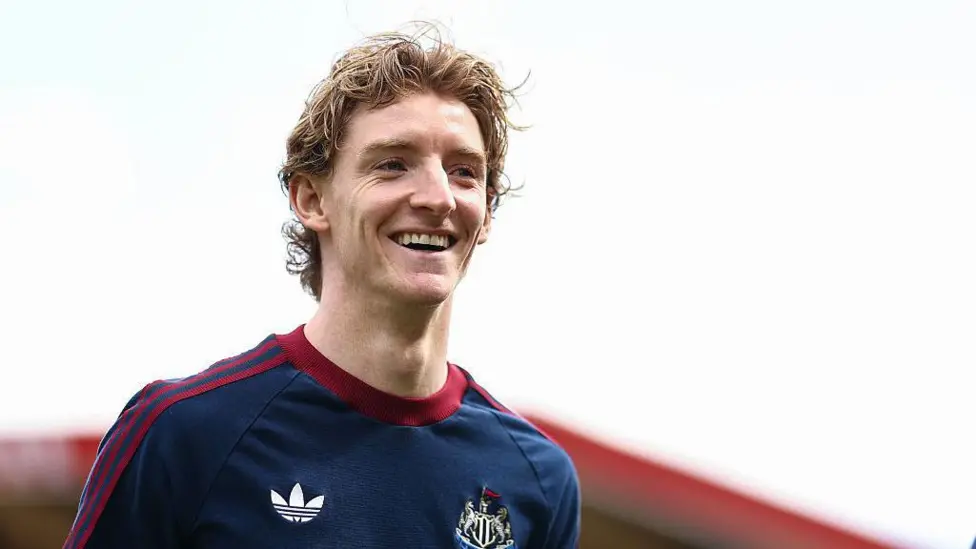
Newcastle United manager Eddie Howe has revealed that his recent team selections are being influenced not only by current performances but also by long-term planning. His decision to leave forward Anthony Gordon on the bench for a second consecutive match has raised questions, especially given the player’s importance to the team this season.
Gordon, who has been Newcastle’s leading goal scorer, has recently attracted serious interest from German giants Bayern Munich. With speculation surrounding his future growing stronger, Howe’s comments suggest that the club is already considering what lies ahead.
Although Gordon had been sidelined briefly in April due to a minor hip flexor injury, he has since regained full fitness. He returned to the squad for matches against Brighton and Nottingham Forest, yet despite being available, he was not used in either game. This was particularly notable in Newcastle’s 1-1 draw against Nottingham Forest, where Gordon remained an unused substitute.
Speaking after the match, Howe explained that Gordon’s absence from the starting lineup was a tactical decision rather than one based on fitness concerns. He emphasized that the team had been performing well without Gordon and that adjustments had been made to improve defensive stability.
According to Howe, Newcastle had struggled defensively in recent months, particularly since the start of the year. As a result, he opted for a different structure that prioritized solidity at the back. This included deploying Joelinton in a wider role and adjusting the formation to better protect the defense.
While acknowledging Gordon’s quality and current fitness, Howe indicated that he is also thinking about the team’s future. His comments hinted at a broader strategy aimed at evaluating players and preparing for the next season.
This forward-looking approach was evident in other selection decisions as well. Notably, Howe chose not to start experienced right-back Kieran Trippier, who is set to leave the club at the end of the season. This decision came despite the fact that Trippier was the only natural right-back available due to injuries affecting other players.
With Lewis Miley and Tino Livramento unavailable, Howe opted to use Lewis Hall — traditionally a left-back — on the right side of defense. Trippier was only introduced late in the match, coming on during stoppage time as a substitute for captain Bruno Guimaraes.
These decisions underline Howe’s intention to experiment and assess alternative options within his squad. By giving opportunities to different players, he hopes to identify those who can contribute to the team’s future success.
Howe openly admitted that he has “one eye on the future,” explaining that part of his responsibility as manager is to evaluate how players might fit into the team moving forward. He stressed the importance of understanding which individuals are capable of stepping up and developing into key contributors.
The match against Nottingham Forest also highlighted the impact of players who were given opportunities. Former Newcastle midfielder Elliot Anderson, now playing for Forest, scored the equaliser that denied his former club victory. His goal canceled out Harvey Barnes’ earlier strike for Newcastle.
Despite the disappointing result, Howe found positives in the performances of certain players. He praised the contributions of substitutes such as Jacob Ramsey, who made a strong impression after coming on. Ramsey’s energy and influence helped Newcastle maintain momentum and create opportunities.
Harvey Barnes was another player singled out for his performance. Having scored Newcastle’s goal, he demonstrated his ability to make an impact when given the chance. Howe expressed satisfaction in seeing players seize their opportunities and contribute to the team.
The manager’s approach reflects a balance between short-term results and long-term planning. While Newcastle are still competing in the current season, Howe is clearly using this period to gather valuable insights into his squad.
This strategy is particularly important given the potential changes that could take place during the summer transfer window. With players like Gordon attracting interest from top European clubs, Newcastle may face difficult decisions regarding their squad composition.
Gordon’s situation is especially significant. As one of the team’s most influential attacking players, his potential departure would leave a gap that Newcastle would need to address. Howe’s decision to experiment with different tactical setups could be part of his preparation for such a scenario.
At the same time, Howe’s emphasis on defensive improvement highlights an area that the team has been working to strengthen. By adjusting the formation and player roles, he aims to create a more balanced and resilient side.
The use of Joelinton in a wider position is one example of this tactical shift. Known for his physicality and work rate, Joelinton can provide additional support to the defense while still contributing to the attack. This flexibility allows Newcastle to adapt their approach depending on the situation.
Howe’s willingness to make bold decisions, even when they involve leaving key players on the bench, demonstrates his commitment to the team’s long-term development. Rather than relying solely on established stars, he is focused on building a cohesive unit that can perform consistently.
The manager also highlighted the importance of giving younger or less experienced players the chance to prove themselves. By exposing them to competitive situations, he hopes to accelerate their growth and prepare them for larger roles in the future.
This approach aligns with Newcastle’s broader ambitions. As the club continues to develop and aim for higher levels of success, having a strong and adaptable squad will be essential.
While some fans may question the decision to bench a player of Gordon’s caliber, Howe’s explanation provides insight into the reasoning behind it. His focus is not just on immediate results but on ensuring the team is well-prepared for the challenges ahead.
As the season progresses, Newcastle’s performances will continue to be shaped by this blend of present and future considerations. Howe’s decisions may carry risks, but they also offer opportunities for growth and improvement.
Ultimately, the manager’s goal is to build a team capable of competing at the highest level over the long term. By evaluating players, experimenting with tactics, and planning ahead, he is laying the groundwork for Newcastle’s future.
Whether it involves integrating new talent, adapting to potential departures, or refining the team’s style of play, Howe’s approach reflects a clear vision. It is a vision focused not only on where Newcastle are now, but on where they aim to be in the seasons to come.