
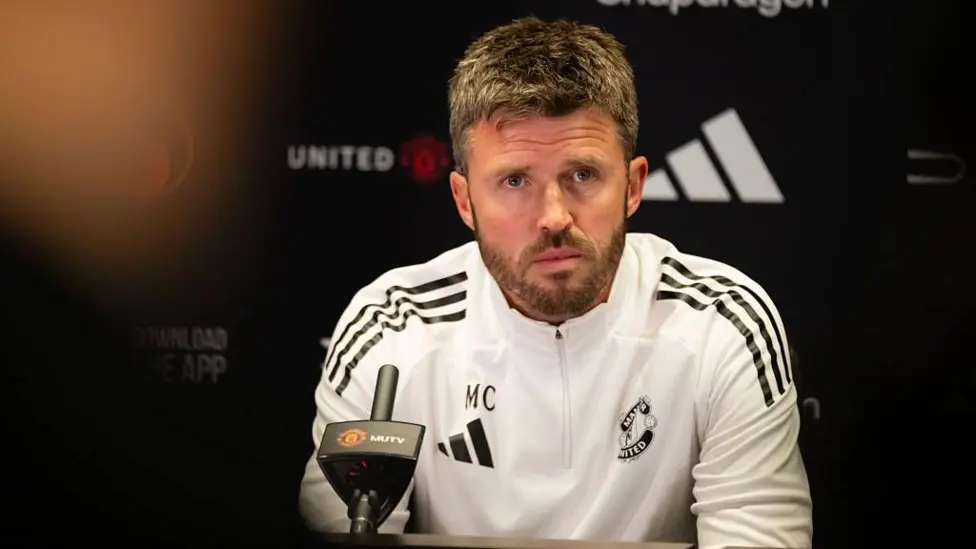
Manchester United are on the verge of officially appointing Michael Carrick as their permanent head coach after reaching a full agreement with the former midfielder. The process of finalizing contracts is currently underway, and the club is expected to confirm the appointment within the next 48 hours.
Although there remains slight uncertainty about whether all formalities will be completed in time for United’s upcoming match against Nottingham Forest on Sunday, there is strong intent within the club to finalize the deal before the season concludes. Ideally, the official announcement will coincide with the team’s final home game, giving supporters an opportunity to celebrate the decision.
Carrick is set to sign a two-year contract, with the option for an additional year based on performance. This long-term commitment reflects the club’s confidence in his ability to lead the team forward after an impressive spell as interim manager.
The 44-year-old has overseen a dramatic turnaround at Old Trafford since taking over from Ruben Amorim, who was dismissed in January following a disappointing run of results. When Carrick stepped into the role on a temporary basis, Manchester United’s season appeared to be in jeopardy, with hopes of securing a top-four finish and Champions League qualification fading rapidly.
However, under Carrick’s leadership, the team has experienced a remarkable resurgence. His tactical adjustments, calm approach, and ability to motivate players have transformed United into one of the most consistent sides in the league during the latter half of the campaign. Champions League qualification, once seen as unrealistic, has now been secured.
United could even finish third in the table if they avoid defeat in their final fixtures, a scenario that seemed highly unlikely when Carrick first assumed control. His success has made him the clear frontrunner for the permanent position, leaving the club’s hierarchy with little doubt about their decision.
The club’s executive leadership team, including chief executive Omar Berrada and director of football Jason Wilcox, strongly recommended Carrick’s appointment to the club’s owners, INEOS. Their endorsement was ultimately approved, paving the way for Carrick to take charge on a permanent basis.
When Carrick was initially appointed as interim coach in January, Manchester United approached the situation with an open mind. The club intended to evaluate multiple candidates before making a long-term decision. At that time, there were still many objectives to play for, and the hierarchy was cautious about rushing into an appointment.
However, Carrick’s performances quickly changed the narrative. He delivered positive results almost immediately, including a notable victory over local rivals Manchester City. While previous managers had also managed to beat City, this win signaled that Carrick was capable of handling high-pressure matches.
A more defining moment came when United defeated Arsenal at the Emirates Stadium, thanks to a late goal from Matheus Cunha. This victory demonstrated that Carrick was bringing a new level of resilience and tactical discipline to the team, suggesting his impact went beyond short-term motivation.
Over the following months, Carrick consistently avoided discussing his future, deflecting questions about whether he wanted the permanent role or had engaged in talks with the club’s hierarchy. He also remained focused on the team’s performance, rather than becoming involved in discussions about transfers or long-term planning.
Meanwhile, other potential managerial candidates gradually became unavailable. Thomas Tuchel extended his contract with the Football Association, effectively removing himself from contention. Carlo Ancelotti committed to a role with Brazil, while Luis Enrique was close to agreeing a new deal with Paris Saint-Germain.
Another possible candidate, Oliver Glasner of Crystal Palace, became involved in internal issues at his club, further narrowing United’s options. As these alternatives disappeared, Carrick’s continued success made the decision increasingly straightforward.
During his tenure, Carrick guided the team to a series of impressive results. He began with four consecutive victories and won six of his first seven matches. His first defeat came against Newcastle, but the club’s leadership largely attributed that loss to player performance rather than coaching decisions.
One notable setback occurred during a home defeat to Leeds United in April. On that occasion, Carrick made a tactical error by starting Manuel Ugarte in place of the injured Kobbie Mainoo, a decision that backfired. However, the team responded strongly, winning three consecutive matches against key rivals for Champions League qualification, including victories over Chelsea, Brentford, and Liverpool.
These results further strengthened Carrick’s case for the permanent role. His ability to learn from mistakes and quickly adapt was seen as a major positive by both the club’s management and supporters.
Support for Carrick also grew within the dressing room. Senior players and emerging talents alike expressed their desire for him to remain as head coach. Among those backing him were Amad Diallo, Bruno Fernandes, Mason Mount, Casemiro, and others. Their support highlighted the strong relationship Carrick had built with the squad.
By this stage, the evidence in his favor was overwhelming. The club’s leadership recognized that choosing another candidate would carry significant risk, especially given the stability and momentum Carrick had established. In contrast, retaining him offered continuity and the promise of further progress.
Ultimately, Manchester United’s decision reflects both practical reasoning and recognition of Carrick’s achievements. While some critics may argue that the club lacked strong alternatives, it is difficult to ignore the results he has delivered. His transformation of the team has exceeded expectations and restored optimism among fans.
Looking ahead, the real test will be whether Carrick can sustain this success over a longer period. Managing Manchester United comes with immense pressure and high expectations, and the challenges of maintaining consistency, competing for major trophies, and managing squad dynamics will require continued growth.
For now, however, the appointment appears to be the right choice. Carrick has demonstrated leadership, tactical awareness, and the ability to inspire his players. His journey from interim coach to permanent manager is a testament to his hard work and the belief placed in him by the club.
As Manchester United prepare to make the announcement official, supporters will hope that Carrick’s tenure marks the beginning of a new and successful era at Old Trafford.