
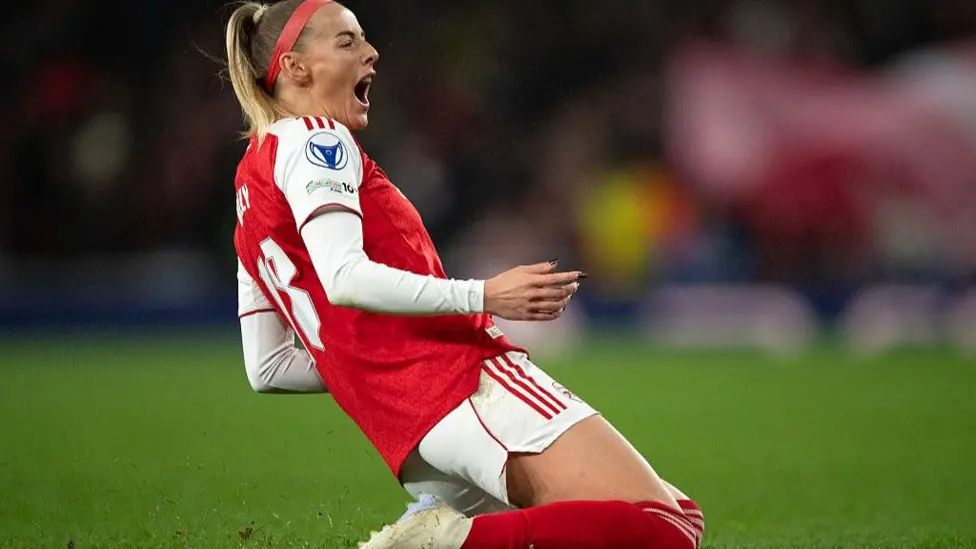
Chloe Kelly has already secured her place in football history, yet her current career phase looks very different from the moments that made her a household name. The iconic shirt celebrations, the dramatic late goals, and the emotional reactions after decisive strikes at major tournaments have all helped cement her legacy. Most famously, she scored the extra-time winner at Euro 2022 that delivered England their first major international trophy, and later converted a crucial penalty in the final to help retain the title three years on. Those moments defined her as one of England’s most influential modern players.
However, despite that reputation, Kelly’s role at both club and international level has become less prominent in recent seasons. The 28-year-old winger is no longer a guaranteed starter for either Arsenal or England. In England’s recent World Cup qualifying matches against Spain and Iceland, she played only a brief nine minutes off the bench, highlighting how her status has shifted from key starter to rotational option.
At club level, her situation has been similarly inconsistent. After a strong spell with Manchester City in 2022–23—where she was a regular starter and featured heavily in the Women’s Super League—her role gradually diminished. Injuries and inconsistent selection limited her influence, and by the 2024–25 season she was starting only sparingly. This frustration eventually led to a public expression of disappointment before her move to Arsenal in January 2025.
Her transfer to Arsenal initially appeared to revitalise her career. She made a strong start, featuring regularly in the second half of the season and even starting key matches, including the Champions League final win over Barcelona. She also delivered decisive performances on the international stage, scoring a winner in a Euro 2025 semi-final against Italy and converting a pressure penalty in the final.
Despite that momentum, the 2025–26 season has again been interrupted by setbacks. After starting the opening league match and scoring, she suffered a knee injury that kept her sidelined for nearly four months. On returning, she showed glimpses of form, including a hat-trick against West Ham in the Women’s Super League and a goal in a Champions League quarter-final against Chelsea. However, she was still dropped to the bench for the return leg at Stamford Bridge, highlighting her uncertain status in the squad.
A key question now surrounds whether Kelly has become more of a “super-sub” than a consistent starter. The statistics suggest a mixed picture depending on context. For Arsenal, her impact as a substitute has been relatively limited, with just one goal and two assists in 14 appearances off the bench. By comparison, teammate Stina Blackstenius has been far more effective in a similar role, scoring consistently after coming on and even delivering a European final-winning goal during the same period.
This contrast suggests that Arsenal currently rely on other players when looking for late-game impact. However, Kelly’s numbers tell a different story when she starts matches. A large majority of her goals for Arsenal have come when she is in the starting lineup, indicating that she performs best with sustained involvement rather than short appearances.
Her situation with England is almost the opposite. At international level, she has developed a reputation as a decisive substitute, often influencing major knockout games from the bench. Since 2022, she has made numerous appearances as a substitute for the Lionesses and has scored key goals in crucial moments, reinforcing her reputation as a clutch performer under pressure. Overall, she has earned 58 caps since Euro 2022, but a significant majority have come as a substitute rather than a starter.
England’s attacking depth also contributes to her rotational role. The national team boasts several high-profile forwards, including Lauren Hemp, Lauren James, Beth Mead, and Jess Park, all competing for attacking positions. This level of competition means even elite players are not guaranteed starting places. Former England striker Ellen White has praised Kelly’s ability to deliver in high-pressure situations, describing her as a world-class talent, while also acknowledging the strength and balance of England’s attacking unit.
At Arsenal, competition is equally intense. Players such as Alessia Russo, Beth Mead, and rising talent Olivia Smith all occupy attacking roles that overlap with Kelly’s preferred position. Russo, in particular, has been highly productive since Kelly’s arrival, while Mead remains a trusted and experienced option on the wing. Smith, a major signing for the club, has also quickly established herself as a regular starter, suggesting Arsenal are building long-term plans around multiple attacking options.
This depth means Arsenal manager Renée Slegers frequently rotates her forward line. While Kelly has started important matches, including Champions League fixtures, she is not always guaranteed selection. Former Arsenal defender Jen Beattie has noted that players in such competitive squads must accept rotation while continuing to push for starting roles, emphasising that talent alone does not guarantee consistent selection at elite clubs.
At 28 years old, Kelly is now at a crucial stage of her career. She remains in her physical and technical prime, with the potential to achieve further success both domestically and in Europe. She could add more major trophies to her already impressive collection in the coming months. However, her long-term role remains uncertain.
The key decision she faces is whether to continue as part of a highly competitive squad at Arsenal, where she rotates regularly but competes for major trophies, or to seek a move where she can secure a more consistent starting role. Such a decision could also impact her international future, as England manager Sarina Wiegman prepares for major tournaments including the upcoming World Cup.
Whatever path she chooses, Kelly’s career remains defined by her ability to deliver in decisive moments. From Euro 2022 glory to Champions League contributions and match-winning international penalties, she has repeatedly shown she thrives when the stakes are highest. The next stage of her journey will determine whether she continues as a key rotational star in elite squads or re-establishes herself as a guaranteed starter at club level.
One thing remains certain: Chloe Kelly’s story in football is far from finished, and her ability to shape big moments ensures she will remain an influential figure in the game.