
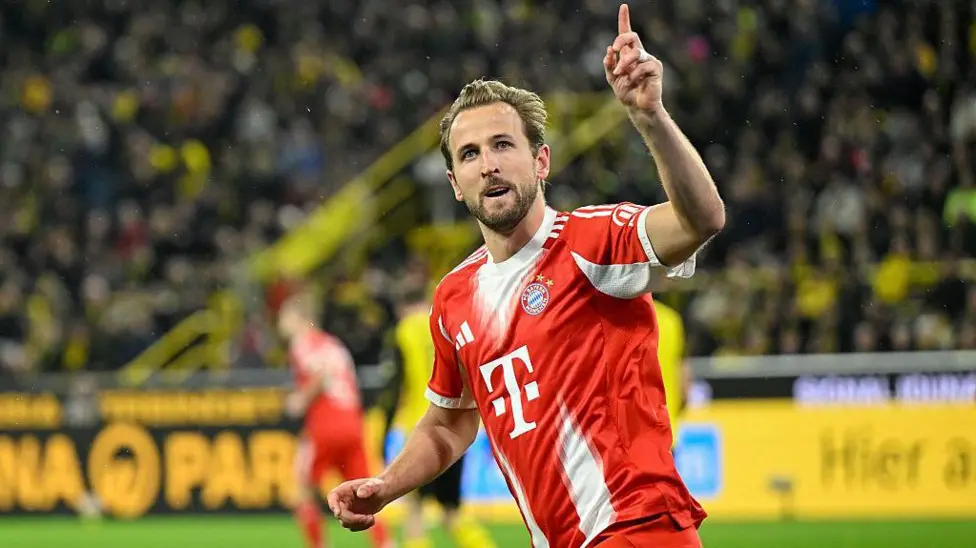
No player across Europe has matched the extraordinary scoring form of Harry Kane this season, but an untimely ankle injury could threaten his chances of finally claiming football’s most prestigious individual honour—the Ballon d’Or. While his numbers have been nothing short of remarkable, history suggests that individual brilliance alone may not be enough to secure the coveted prize.
Kane has enjoyed a phenomenal campaign, scoring an astonishing 53 goals in just 45 appearances for both club and country. His consistency, composure, and clinical finishing have made him the standout performer in European football this season. However, despite these incredible statistics, Kane is well aware that personal achievements must be complemented by team success if he is to win the Ballon d’Or.
This is why his fitness has become such a major concern. The England captain recently missed Bayern Munich’s dramatic 3-2 victory over Freiburg due to an ankle problem. With a crucial UEFA Champions League quarter-final clash against Real Madrid looming, his availability could play a decisive role not only in Bayern’s season but also in his Ballon d’Or ambitions.
Although Kane ended his long wait for silverware by winning the Bundesliga title last season, additional domestic success in Germany is unlikely to sway Ballon d’Or voters. The award has evolved significantly over the years and is no longer based solely on individual brilliance. Instead, it increasingly rewards players who shine while leading their teams to major trophies such as the Champions League, the World Cup, or continental championships like the European Championship.
Kane himself has openly acknowledged this reality. Earlier in the season, he admitted that even scoring 100 goals would not guarantee him the Ballon d’Or if he fails to win one of football’s biggest titles. His comments reflect a broader trend that has defined the award over the past two decades.
Since 2006, nearly 80% of Ballon d’Or winners have lifted either the Champions League or a major international trophy in the same year. This pattern highlights the importance of team success in the voting process. Only a few exceptional players have managed to break this trend, most notably Lionel Messi and Cristiano Ronaldo, whose individual brilliance often transcended team achievements.
Messi claimed the award in 2010, 2012, and 2019 without winning the Champions League, while Ronaldo secured it in 2013 despite Real Madrid falling short in Europe. However, both players are widely regarded as generational talents, making their cases exceptional rather than typical.
In recent years, the connection between major trophies and Ballon d’Or success has become even stronger. Ten of the last eleven winners have lifted either the Champions League or a major international trophy, including each of the past five recipients. This trend has been further reinforced by changes to the award’s criteria.
Originally, the Ballon d’Or was based on performances over a calendar year. However, since 2022, it has been aligned with the European football season, running from August to July. This adjustment places greater emphasis on key competitions such as the Champions League and international tournaments, making them even more influential in determining the winner.
Voting for the award is conducted by journalists from the top 100 FIFA-ranked nations. They are instructed to consider individual performances, sportsmanship, and team achievements. In practice, however, it is often the latter that proves decisive, particularly when candidates are closely matched in terms of personal statistics.
For Kane, this means that his best opportunity to secure the Ballon d’Or may lie in Bayern’s Champions League campaign. The upcoming clash with Real Madrid at the Santiago Bernabéu represents a defining moment in his season. A strong performance on such a stage could significantly boost his credentials, while a disappointing result could weaken his case.
Adding another layer of intrigue to the encounter is the presence of Kylian Mbappe on the opposing side. Like Kane, Mbappé has yet to win the Ballon d’Or but is widely considered one of the leading contenders this year. The French forward has scored 38 goals and contributed to 43 goal involvements across all competitions, making him one of the most productive players in Europe.
Mbappé is also the top scorer in this season’s Champions League, with 13 goals—just four shy of the all-time single-season record. If he can lead Real Madrid to European glory or guide France to success in the upcoming World Cup, his chances of winning the Ballon d’Or will increase significantly.
The competition does not end there. Another emerging contender is Michael Olise, Kane’s teammate at Bayern. The former Crystal Palace winger has enjoyed a breakthrough season, contributing an impressive 24 assists—the highest tally in Europe’s top leagues. His creativity and influence have made him a key player for both club and country.
Meanwhile, Barcelona’s rising star Lamine Yamal continues to attract attention. Despite his young age, Yamal has already established himself as one of the most exciting talents in world football. Having finished as the runner-up for the 2025 Ballon d’Or, he could go one step further this year, especially if he plays a pivotal role for Spain at the World Cup.
Other players who could enter the conversation include Brazilian wingers Vinicius Jr and Raphinha. While they may currently be overshadowed by teammates and rivals, strong performances in major tournaments could elevate their status and bring them into contention.
The upcoming World Cup in North America adds another dimension to the race. It provides players with a second opportunity to strengthen their Ballon d’Or cases. For Kane, leading England to success on the global stage would significantly enhance his chances. However, it also increases the competition, as players from around the world will have a chance to shine.
Veteran stars Messi and Ronaldo could also make a final push for the award. Although both are now playing outside Europe, they remain eligible and could be judged primarily on their international performances. A standout showing at the World Cup could see either player add to their already impressive collection of Ballon d’Or titles.
Historically, British players have had limited success in the Ballon d’Or. The award has been won by a British player only seven times, with the last victory coming in 2001 when Michael Owen claimed the prize. Other notable winners include Stanley Matthews, Denis Law, Bobby Charlton, and George Best.
In more recent years, only a handful of British players have come close. Frank Lampard finished as runner-up in 2005, while Steven Gerrard placed third. More recently, Jude Bellingham secured a third-place finish in 2024.
Kane could take inspiration from Kevin Keegan, who won back-to-back Ballon d’Or titles while playing in Germany. However, it is worth noting that no player from a German club has won the award since 1996, when Matthias Sammer claimed the honour.
In conclusion, Harry Kane’s remarkable goal-scoring season has placed him firmly in the Ballon d’Or conversation. However, his chances will ultimately depend on his ability to combine individual brilliance with team success. With crucial matches ahead in both the Champions League and the World Cup, the coming months will determine whether he can finally achieve football’s ultimate individual accolade.
For more football news, updates, and in-depth analysis, visit https://netsports247.com