

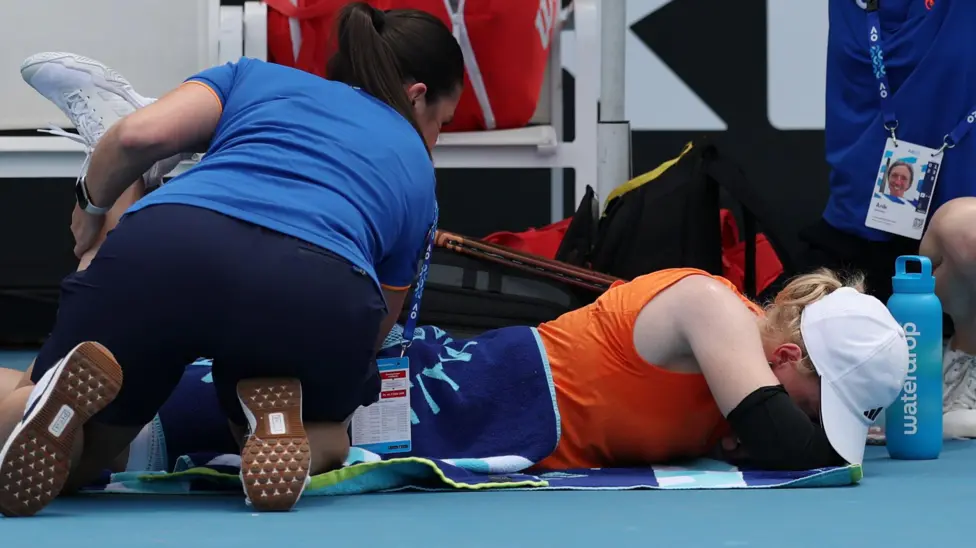
Britain’s Francesca Jones endured a heartbreaking Australian Open exit as injury once again denied her the chance to record her first main-draw victory at Melbourne Park, leaving the 25-year-old in visible distress as she was forced to retire during her opening-round match.
Jones, ranked 71 in the world and Britain’s number three, was unable to complete her contest against Polish qualifier Linda Klimovicova on Monday, withdrawing while trailing 6-2, 3-2. The emotional toll was evident as Jones sobbed loudly on court, struggling to come to terms with another cruel setback at a Grand Slam that has repeatedly tested her resilience.
From the early stages of the match, it was clear something was wrong. Jones laboured in her movement almost from the outset, unable to chase balls with her usual intensity or defend the baseline effectively. Klimovicova, sensing her opponent’s discomfort, played with composure and consistency, taking advantage of Jones’ limited mobility to control rallies and dictate play.
This painful episode came just days after Jones had been forced to withdraw from a match at the Auckland International because of a groin issue, raising concerns about her physical readiness heading into the Australian Open. While the injury in Auckland affected her groin, it was a separate glute problem that ultimately ended her hopes in Melbourne, compounding her frustration and disappointment.
As day two of the Australian Open unfolded, early retirements became an unfortunate theme, highlighting the physical demands of elite tennis in punishing summer conditions. Men’s eighth seed Felix Auger-Aliassime was among those forced to abandon his match after suffering severe cramping, while qualifier Marina Stakusic had to be taken off court in a wheelchair, unable to continue due to similar issues. Jones’ retirement added to a growing list of players sidelined by physical problems during the opening rounds.
Despite her obvious discomfort, Jones showed immense courage in attempting to continue. After dropping the opening set 6-2, she took a medical timeout, receiving treatment in the hope of easing the pain and regaining some mobility. The physio worked on her glute area, but the issue persisted, and Jones returned to the court still visibly hampered.
The second set offered little respite. Jones continued to struggle through her service games, and after the third and fifth games she required further medical attention. Each pause in play underlined the seriousness of the injury, with Jones increasingly emotional as she battled both physical pain and the crushing realization that her match, and perhaps her tournament, was slipping away.
In the fifth game of the second set, Jones was broken to love, unable to generate the movement or power required to hold serve. As she sat on her chair receiving treatment once more, tears flowed freely, capturing the raw emotion of an athlete watching months of preparation unravel in front of her.
Eventually, after briefly returning to her feet, Jones approached the net and signalled to Klimovicova that she could not continue. The Polish qualifier offered her sympathy, while the crowd responded with warm applause, acknowledging Jones’ bravery and the misfortune that had cut short her campaign.
For Jones, the retirement was another painful chapter in a career defined as much by perseverance as by potential. Born with ectrodactyly ectodermal dysplasia, a rare genetic condition that affects the development of fingers and toes, Jones has long been admired for her determination to compete at the highest level of professional tennis. Her journey to the world’s top 100 has been marked by resilience, making moments like this all the more difficult to endure.
The Australian Open has proven particularly unforgiving for the Briton. Despite multiple appearances in Melbourne, a first main-draw win continues to elude her, with injuries and tough draws repeatedly standing in her way. This latest setback, coming so early in the match, will undoubtedly be among the most emotionally draining she has experienced.
Klimovicova, meanwhile, advanced to the second round under unfortunate circumstances. While she played solidly and capitalized on her opponent’s limitations, the manner of her progression was overshadowed by concern for Jones, whose tears and visible anguish left a lasting impression on Rod Laver Arena.
Tournament organizers and fellow players have increasingly voiced concerns about player welfare, particularly during the Australian summer, where high temperatures and intense physical demands often push athletes to their limits. The spate of early retirements on day two reinforced those concerns, prompting renewed discussion about scheduling, recovery time, and player health.
For British tennis, Jones’ withdrawal was a blow, especially given her steady rise over the past year. Her ranking of 71 reflects significant progress, and when fully fit, she has shown the ability to compete with and defeat higher-ranked opponents. The challenge now will be recovery, both physically and mentally, as she looks to regroup after another cruel interruption.
As Jones left the court, supported by medical staff and applauded by spectators, the moment served as a stark reminder of the fine margins in professional sport. Talent, preparation, and determination can all be undone in an instant by injury, leaving athletes to pick up the pieces and start again.
While the Australian Open continues with its usual drama and spectacle, Jones’ emotional exit stood out as one of the most poignant moments of the early rounds. Her courage in attempting to continue despite obvious pain earned widespread respect, even as fate once again denied her the breakthrough she has worked so tirelessly to achieve.
Jones will now turn her focus to recovery, hoping the glute problem can be resolved quickly enough to avoid further disruption to her season. For a player who has overcome countless obstacles simply to compete on tennis’ biggest stages, there is little doubt she will fight her way back once more.
Her story, though marked by disappointment in Melbourne, remains one of resilience and determination, qualities that continue to define her career. Full coverage and more tennis news can be found at netsports247.com.