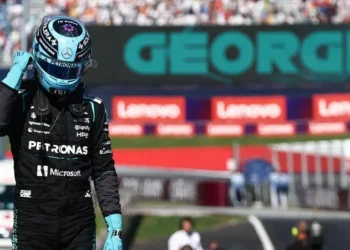

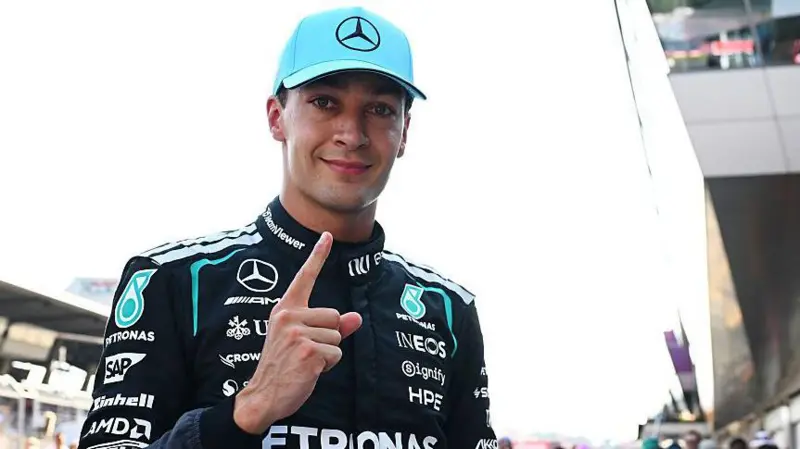
Mercedes driver George Russell produced a dramatic and controversial performance to secure pole position at the Austrian Grand Prix, edging out Ferrari’s Charles Leclerc with a stunning lap at the very end of the qualifying session.
The outcome was surrounded by controversy due to the circumstances under which Russell set his fastest time. During his decisive lap, yellow flags were displayed following a crash involving Red Bull’s Max Verstappen at the penultimate corner of the circuit. Despite passing through the affected area, Russell managed to complete his lap and improve his time, ultimately claiming the top spot on the grid.
Russell’s Mercedes team-mate, Kimi Antonelli, was running just ahead of him on track at the time of the incident. However, unlike Russell, Antonelli chose not to push for a faster lap after encountering the yellow flags and will start the race from fourth position. His decision not to improve highlighted the confusion surrounding the situation and the interpretation of the flag signals.
Behind the leading trio of Russell, Leclerc, and Lewis Hamilton, Verstappen will start in fifth place despite crashing during the session. McLaren drivers Lando Norris and Oscar Piastri qualified sixth and seventh respectively, both finishing just behind Verstappen in a closely contested field.
Following the session, Russell defended his actions, stating that he had reduced his speed sufficiently when approaching the incident zone. He explained that only a single yellow flag had been displayed at the time he passed the crash site, rather than the more severe double waved yellow flags that would have required a greater reduction in speed.
However, the situation was complicated by conflicting information. While trackside light panels initially showed a single yellow flag, official race control documentation later indicated that double waved yellow flags had been in effect at that section of the track. This discrepancy created uncertainty about whether drivers had responded appropriately to the conditions.
An FIA spokesperson later clarified the sequence of events, explaining that a single yellow flag had been shown initially and was subsequently upgraded to double yellows. By the time this escalation occurred, both Russell and Antonelli had already passed through the area, which played a key role in the controversy surrounding the incident.
Russell described his lap in detail, emphasizing that he had lifted off the throttle significantly before entering the corner where the crash had occurred. According to him, he was ahead of his previous best time by half a second going into the corner and maintained a quarter-second advantage as he exited. This careful balance between caution and performance allowed him to complete what he described as a “great lap.”
He also mentioned a conversation with Mercedes team principal Toto Wolff, who reassured him that his actions had complied with the regulations regarding yellow flags. Russell noted that he had lifted approximately 100 meters before the corner, which he believed demonstrated his adherence to the rules.
Antonelli, however, expressed a different perspective on the situation. He believed that double yellow flags had been displayed and chose to abort his lap entirely as a result. This decision cost him a chance at securing a front-row starting position, as he was unable to improve on his earlier time.
Reflecting on his choice, Antonelli admitted that he may have been overly cautious. He acknowledged that, in hindsight, he might have been able to challenge Russell more closely for a higher grid position had he continued pushing. Despite this, he accepted responsibility for the outcome, describing it as his own mistake.
The dramatic turn of events was triggered by Verstappen’s crash, which occurred during the final moments of the session. The Red Bull driver lost control of his car while navigating a fast, downhill right-hand corner, causing him to spin across the gravel and collide with the barrier. The incident brought out the yellow flags and disrupted the final runs of several drivers.
Ferrari and McLaren drivers had completed their laps before Verstappen’s crash, which initially appeared to secure a strong result for Ferrari. Leclerc delivered an impressive lap that placed him just ahead of his team-mate Hamilton, who had been performing slightly better throughout the weekend.
Hamilton encountered difficulties during his first attempt in the final qualifying segment (Q3), making an error by locking a brake at Turn Three. This mistake forced him to abandon that lap, leaving him with only one opportunity to set a competitive time. As a result, he approached his final run with a different balance of risk and caution, ultimately falling just short of surpassing Leclerc.
Antonelli’s decision to slow down significantly during his final lap further impacted the overall results. He lost nearly two seconds compared to his earlier effort, which dropped him out of contention for a front-row start.
Verstappen’s earlier lap time, which had placed him third at the time, proved sufficient to secure fifth place on the grid despite his crash. Meanwhile, McLaren’s Norris and Piastri both improved their lap times during their final runs but were unable to move ahead of Verstappen. Norris finished just 0.027 seconds behind the Red Bull driver, with Piastri a further 0.009 seconds adrift.
The remainder of the top ten featured a mix of emerging talent and competitive midfield teams. Red Bull’s Isack Hadjar, along with Racing Bulls drivers Liam Lawson and Arvid Lindblad, completed the top positions, showcasing the depth of competition in the field.
Overall, the qualifying session at the Austrian Grand Prix delivered high drama and intense debate. Russell’s pole position lap, achieved under contentious circumstances, has set the stage for an intriguing race, with questions lingering over the interpretation of the yellow flag rules and their impact on the final outcome.
For more latest sports news and updates, visit: https://netsports247.com/