
Galatasaray have intensified their ongoing dispute with football authorities in Turkey by launching a strong and highly controversial criticism of referees during their latest league fixture. The Turkish giants accused match officials of harboring “evil intentions,” highlighting the growing tension between top clubs and the officiating system in the country.
The accusations came during Galatasaray’s commanding 3-0 victory over fierce Istanbul rivals Fenerbahce, a result that significantly strengthened their position at the top of the Turkish Super Lig table. However, despite the impressive performance and comfortable win, much of the attention shifted away from the football itself and toward the club’s explosive statements regarding refereeing decisions.
At halftime, with Galatasaray holding a narrow 1-0 lead, the club took to social media platform X to express their frustration. In a series of posts, they claimed that two clear penalty opportunities had been denied by the officials. The club suggested that these decisions were not simply mistakes but part of a broader pattern of unfair treatment.
Their statements went beyond typical criticism, using unusually strong language to describe the situation. Galatasaray declared that they could see what the referees were doing and accused them of having hidden motives. They warned that such behavior would not continue unchecked and insisted that they would not remain silent in the face of what they perceived as injustice.
This bold stance reflects a wider breakdown in relations between Galatasaray and the Turkish Football Federation (TFF). Just days before the match, club president Dursun Aydin Ozbek announced that the club had suspended all relations with the federation under its current leadership. This decision underscored the depth of dissatisfaction within the club and set the stage for the dramatic events that followed.
On the pitch, Galatasaray delivered a strong performance that justified their league-leading status. Victor Osimhen opened the scoring, giving his side an early advantage. In the second half, Baris Yilmaz and Lucas Torreira added further goals, ensuring a comprehensive victory that extended Galatasaray’s lead at the top of the table to seven points with only three matches remaining.
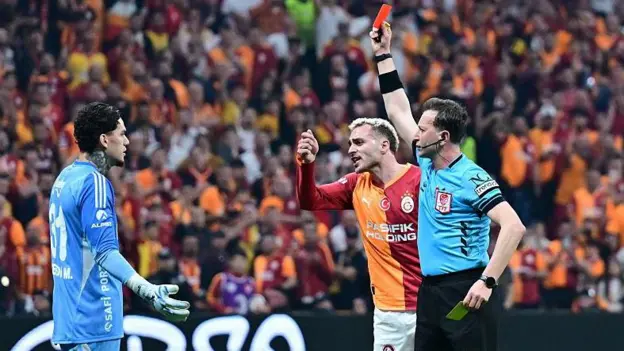
Despite their dominance, the match was not without controversy. Fenerbahce were awarded a penalty in the first half but failed to convert it, missing an opportunity to level the score. Later in the game, they were reduced to ten players after goalkeeper Ederson, formerly of Manchester City, was shown a red card by referee Yasin Kol. These incidents added further complexity to an already heated encounter.
The rivalry between Galatasaray and Fenerbahce is one of the most intense in world football, and matches between the two sides are often charged with emotion. However, the focus on refereeing decisions in this particular game highlighted deeper issues within Turkish football.
In recent years, disputes involving referees have become increasingly common in the Turkish Super Lig. Clubs have frequently voiced concerns about the consistency and fairness of officiating, leading to a climate of mistrust and tension. Galatasaray’s latest comments are perhaps the most extreme example of this growing frustration.
One of the most notable incidents occurred in 2023, when referee Halil Umut Meler was physically attacked by Faruk Koca, the president of MKE Ankaragucu, following a match. The shocking event led to the temporary suspension of the league and drew international condemnation. It also raised serious questions about the safety of officials and the overall environment within Turkish football.
The following year, controversy continued when Jose Mourinho, then manager of Fenerbahce, received a one-match ban and a significant fine for comments that appeared to question the impartiality of referees. His remarks added to the ongoing debate about officiating standards and further strained relations between clubs and governing bodies.
There have also been multiple instances of teams walking off the pitch in protest over refereeing decisions. Such actions demonstrate the extent to which dissatisfaction has escalated, with clubs feeling compelled to take drastic measures to make their voices heard.
Galatasaray’s decision to suspend relations with the TFF represents a significant escalation in this ongoing conflict. By taking such a step, the club is effectively challenging the authority of the governing body and calling for changes to the current system. Their public criticism of referees during a high-profile match only reinforces their position.
The issue of refereeing integrity has also been brought into focus by investigations conducted in recent years. In one notable case, the Turkish Football Federation suspended 149 referees and assistant referees after it was discovered that many had betting accounts. This revelation further undermined confidence in the officiating system and fueled suspicions among clubs and supporters.
Against this backdrop, Galatasaray’s accusations can be seen as part of a broader struggle for transparency and accountability in Turkish football. While their choice of language has been widely criticized, it reflects the intensity of their frustration and the seriousness with which they view the issue.
From a sporting perspective, Galatasaray’s victory over Fenerbahce was a significant step toward securing the league title. With a seven-point lead and only a few matches remaining, they are in a strong position to finish the season as champions. However, the controversy surrounding the match has overshadowed their achievement.
The situation also raises important questions about the role of social media in modern football. By using platforms like X to voice their concerns, clubs can communicate directly with fans and shape public opinion. However, such statements can also escalate tensions and contribute to a more hostile environment.
Looking ahead, the relationship between Galatasaray, the Turkish Football Federation, and match officials will be closely watched. Any further incidents could have serious implications for the stability of the league and the reputation of Turkish football on the international stage.
In conclusion, Galatasaray’s explosive criticism of referees during their victory over Fenerbahce highlights the deep-rooted issues within Turkish football. While the club’s frustration is understandable given the broader context, their remarks have added fuel to an already volatile situation. As the season draws to a close, the focus will not only be on the title race but also on how these tensions are addressed moving forward.