
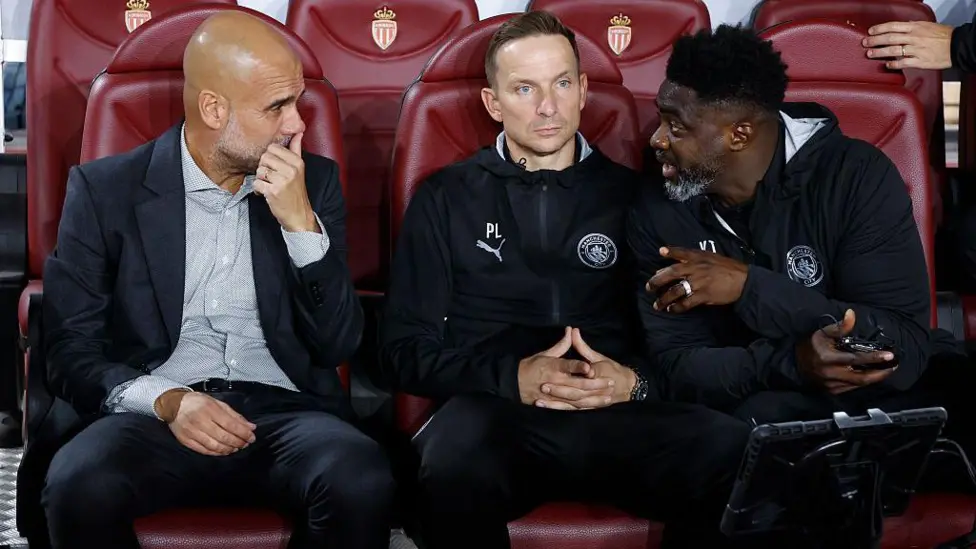
Pep Guardiola has built a reputation for perfectly timing his teams’ peak performance across a season. Much like a well-written television series that follows a familiar arc, his time at Manchester City often begins with early promise, dips into moments of uncertainty, and then rises dramatically toward a powerful finish. Year after year, critics question whether City’s dominance is fading, only for Guardiola to adjust, refine, and guide his side to success—often culminating in silverware.
Whether this familiar pattern will repeat itself this season remains uncertain. However, one thing is clear: Guardiola appears to have finally discovered a tactical system he trusts heading into the decisive stretch of the campaign. The journey to reach this point has been anything but smooth, marked by experimentation, setbacks, and gradual evolution.
Early season promise and experimentation
Manchester City’s campaign began in emphatic fashion with a commanding 4-0 victory over Wolves. Yet, even in that opening game, the foundations of Guardiola’s tactical experimentation were visible. Of the players who started a crucial late-season win over Arsenal, only a handful were present in that first match—highlighting just how much the team has changed.
In the early weeks, Guardiola deployed an unconventional structure. Full-backs such as Rico Lewis and Rayan Aït-Nouri drifted into central areas, supporting midfield anchor Nico Gonzalez, while creative players like Bernardo Silva and Tijjani Reijnders pushed forward. Out of possession, City pressed aggressively, with wingers staying close to Erling Haaland. However, this often left space out wide, allowing opponents to exploit the flanks.
At this stage, City embraced a faster, more direct attacking style. Influenced in part by assistant coach Pep Lijnders and new signings, the team looked to transition quickly from defense to attack. This approach suited Haaland’s strengths perfectly, enabling him to make runs behind defenses and score freely. Yet, as the season progressed, Guardiola began to scale back this directness, preferring a more controlled style of play.
Early setbacks and tactical challenges
Despite their strong start, City soon encountered difficulties. A surprising 2-0 defeat at home to Tottenham Hotspur exposed vulnerabilities in their system. Guardiola made changes to personnel, bringing in players like Omar Marmoush and Rayan Cherki, but the core tactical ideas remained the same.
Opponents began to adapt, using man-to-man pressing to disrupt City’s build-up play. Guardiola attempted to counter this by inviting pressure and then playing long balls to Haaland and Marmoush, creating one-on-one situations in advanced areas. However, this strategy was not always effective, particularly when opponents exploited spaces left by City’s aggressive positioning.
Defensively, City struggled with balance. Their high line and pressing structure were often exposed by teams that could switch play quickly or overload wide areas. This was evident in defeats to teams like Brighton, where City’s defensive shape appeared disjointed and vulnerable.
Gradual improvement and key tactical insights
As the season progressed, Guardiola began to identify patterns and solutions. A significant turning point came in the Manchester derby, where City secured a convincing 3-0 victory over Manchester United. In that match, the movement of Jeremy Doku proved crucial.
Doku frequently drifted inside from the wing, creating overloads in midfield and opening space for overlapping runs from full-backs. This tactical tweak added a new dimension to City’s attack and became a recurring feature in their play. The ability to create numerical superiority in central areas helped City regain control of matches.
At the same time, Guardiola continued to experiment with midfield combinations. Players like Phil Foden and Reijnders were given more attacking responsibilities, while others provided defensive stability. The manager’s goal was to strike the perfect balance between creativity and control.
The importance of physicality and adaptability
A defeat to Aston Villa later in the season highlighted another key lesson: the importance of physicality. Villa’s ability to bypass City’s press and impose themselves physically forced Guardiola to rethink his approach. Substitutions made during that game hinted at a shift toward a more robust and dynamic system.
City began to rely more on players who could contribute both defensively and offensively. Nico O’Reilly, for example, emerged as a valuable asset due to his ability to score goals while also providing defensive cover. This dual contribution allowed Guardiola to adjust his midfield structure without sacrificing attacking threat.
Evolution of the attack
In the attacking third, Guardiola experimented with different configurations. At times, he used traditional wingers to stretch the pitch, while in other matches, he opted for narrower forward lines. The goal was to create unpredictability and exploit defensive weaknesses.
One notable adjustment was the use of multiple central attackers alongside Haaland. Players like Marmoush and Antoine Semenyo were deployed in roles that blurred the lines between winger and striker. This created space for others and made it more difficult for defenders to focus solely on Haaland.
The manager also sought to reduce his team’s reliance on Haaland for goals. By encouraging midfielders and wide players to contribute more in attack, City became less predictable and more balanced.
Finding the winning formula
By the latter stages of the season, Guardiola had finally settled on a system that brought together the best elements of his earlier experiments. This was evident in City’s Carabao Cup final victory over Arsenal, where the team displayed both attacking fluidity and defensive solidity.
The new system featured a dynamic front line supported by a strong midfield base. Players like Cherki, Doku, and Semenyo provided creativity and movement, while Silva and Rodri ensured stability behind them. Full-backs contributed both defensively and offensively, adding flexibility to the overall structure.
Defensively, City adopted a more compact shape, pressing intelligently rather than aggressively. This reduced the spaces opponents could exploit and allowed City to regain control of matches.
Guardiola’s defining strength
What sets Guardiola apart is not just his tactical knowledge, but his ability to adapt and evolve. Throughout the season, he continuously assessed his team’s strengths and weaknesses, making adjustments to suit both his players and the challenges posed by opponents.
Contrary to the common belief that “playing like Guardiola” means replicating a specific style, his true philosophy lies in adaptability. He does not rely on a single system; instead, he builds his approach around the players available to him and the demands of the competition.
This flexibility has been a key factor in Manchester City’s sustained success. While financial resources have undoubtedly played a role, it is Guardiola’s tactical intelligence and willingness to innovate that have allowed the team to remain at the top.
Looking ahead
As the season approaches its climax, the question remains whether Guardiola’s latest tactical evolution will once again lead Manchester City to glory in the Premier League. History suggests that his teams often peak at just the right moment, but the competition is fierce, and nothing is guaranteed.
What is certain, however, is that Guardiola has once again demonstrated his ability to navigate challenges and reinvent his team. Whether or not this results in another title, his influence on the game and his reputation as one of football’s greatest tacticians remain firmly intact.
For more football news, tactical analysis, and updates, visit:
👉 https://netsports247.com/