

Here’s how to play Skyjo in a nutshell: deal everyone 12 face down cards in a grid of three rows and four columns, flip two, then take turns swapping cards to drive your total as low as you can. Three matching cards in a column vanish. Once a player hits 100 points, the lowest total wins.
That’s the short version. If you’ve seen the stories about England’s squad getting hooked on it during the 2026 World Cup and fancy a go yourself, the full walkthrough below will have you playing properly by the end of your first round.
Why England’s players got hooked on Skyjo
The game landed in the England camp thanks to Jude Bellingham. Morgan Rogers told BBC Sport that Bellingham had bought it, that he’d never seen it before, and that a few of the lads were “addicted at the moment.” According to GiveMeSport’s write up of those comments, Rogers played a game with Bellingham, Jordan Henderson, Dan Burn, Anthony Gordon and Elliot Anderson after the group cycled to a coffee shop. Rogers won, naturally.
The squad was based in Kansas City for the tournament, and the syndicated BBC report on AOL noted that Skyjo sat alongside social deduction games like Wolf and Imposter as the players’ go to ways of filling downtime. It’s easy to see the appeal. A round is quick, the rules fit on a napkin, and there’s just enough needle to keep a group of competitive footballers interested.
What’s in the box
Skyjo was designed by Alexander Bernhardt and published by Magilano in 2015. It plays with 2 to 8 people, it’s pitched at ages 8 and up, and a full game usually takes 30 to 60 minutes. The deck has 150 cards running from minus 2 up to 12, and the spread matters more than you’d think, because it tells you how rare the good cards are.
| Card value | Copies in the deck | What it means for you |
|---|---|---|
| Minus 2 | 5 | The best card in the game, and the rarest |
| Minus 1 | 10 | Always worth grabbing |
| 0 | 15 | The most common single value; great column material |
| 1 to 12 | 10 of each | Anything from 9 up is a card you want gone |
How to play Skyjo: setup and your first turn
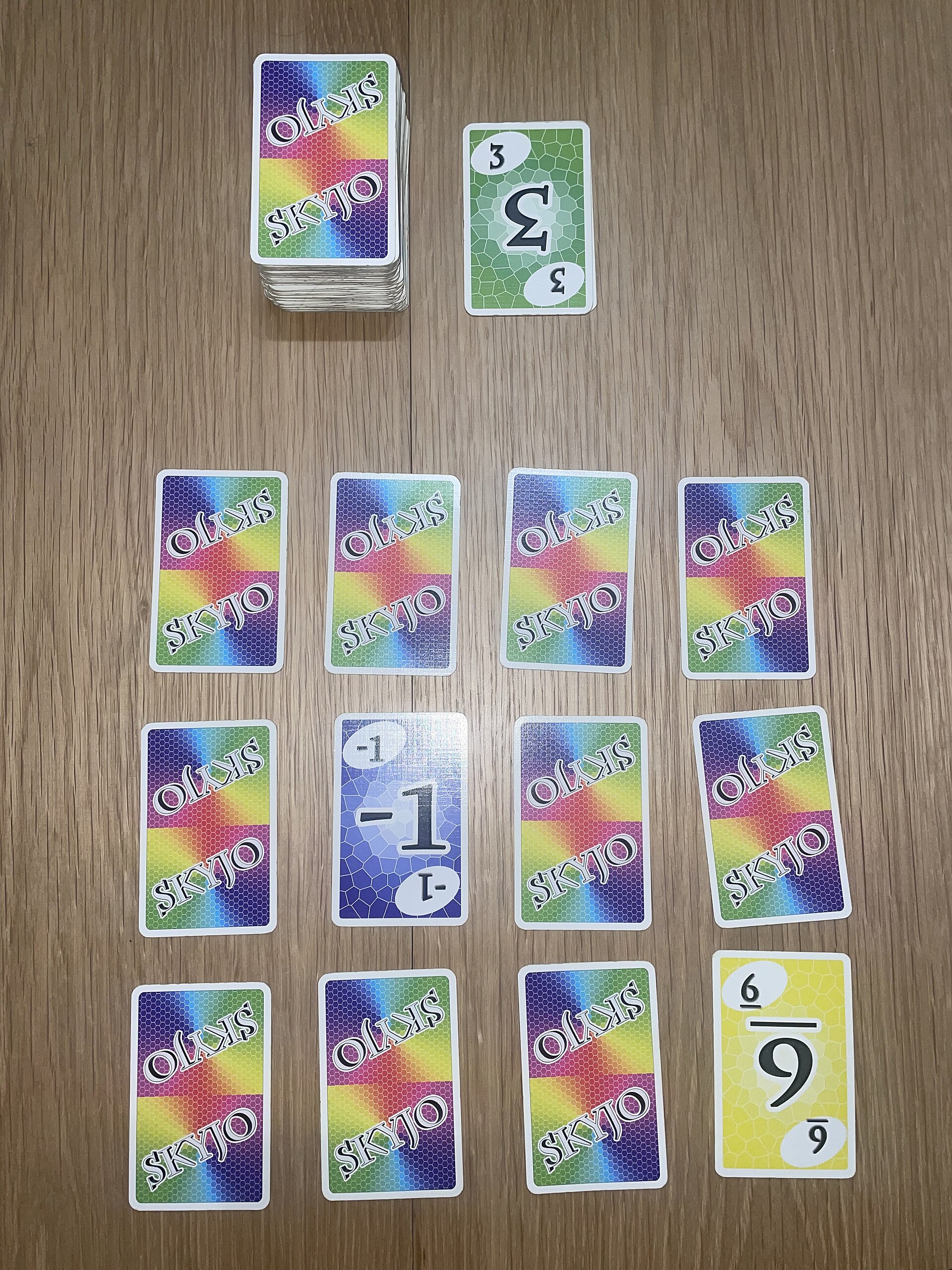
Shuffle the deck and deal 12 cards face down to each player. Nobody looks at them. Each person lays their cards out in a grid of three rows by four columns, so you end up with four vertical columns of three cards. Put the rest of the deck in the middle as the draw pile, then turn its top card over to start the discard pile.
Next, everyone flips any two of their own cards face up. Add them together. Whoever shows the highest total goes first, and play then moves clockwise.
On your turn you pick one of two options:
- Take the top discard. If you go for the face up card, you must swap it into your grid. It can replace a face up card or a face down one. Whatever you replace goes onto the discard pile face up.
- Draw from the pile. Look at the card. You can swap it into your grid the same way, or you can throw it straight onto the discard pile and flip one of your face down cards instead.
That second choice is the heart of the game. A blind draw can land you a minus 2, or it can hand you a 12 that you’d rather bin while you peek at another hidden card.
Clearing columns
Here’s the rule that makes Skyjo more than a simple adding game. If you ever have three face up cards of the same value in one vertical column, the whole column gets removed and discarded. Those cards stop counting towards your score. Geeky Hobbies’ rules guide points out that more than one column can go if you’ve lined them up.
Clearing a column of 10s wipes 30 points off your total, which is huge. Clearing a column of zeros doesn’t change your score, though it does shrink your grid, and that can help you finish a round sooner. Some rule summaries, like the one on GameRules.com, flag column clearing as a special rule, but it’s how most people play.
Ending a round and scoring
A round ends when one player has turned every card in their grid face up. Everyone else then gets one more turn. After that, all remaining face down cards are flipped and each player adds up their grid. Negative cards knock points off.
Now the twist. The player who ended the round needs to have the lowest score. If somebody else finished lower, the person who went out has their round score doubled. That penalty only bites when their score is above zero, so going out on a negative or zero total is safe. It’s a proper gamble, and it’s where most of the table banter comes from.
Scores carry over from round to round. As soon as anyone reaches 100 points or more at the end of a round, the game stops, and the player with the lowest running total wins.
Strategy tips for your first few games
- Dump the big numbers early. Swap out 9s, 10s, 11s and 12s whenever something lower comes along. A face up 12 is a liability every turn you keep it.
- Watch the discard pile. What your neighbour throws away is a clue to what they’re chasing, and it’s also the only card you can plan around, because you already know its value.
- Build columns on purpose. Two matching cards in a column is a live threat. With 15 zeros and 10 copies of every other number, you’ve got decent odds of finding the third.
- Don’t rush to go out. Flipping your last card while an opponent is sitting on a lower total gets you doubled. Check the other grids before you end it.
- Use the discard and flip move. Discarding a bad draw and revealing a hidden card gives you information for free and nudges the round forward.
- Count what’s gone. With only five minus 2s in the deck, once a few have shown up you can stop waiting for one.
If Bellingham’s crowd can get competitive over it between training sessions, it’ll work just as well at your kitchen table. The rules take five minutes to learn, and nobody needs to be good at maths to enjoy it.
FAQ
How many players can play Skyjo?
Skyjo works for 2 to 8 players, and the box recommends it for ages 8 and up. It’s at its liveliest with four or more, since there are more discards to read.
Who brought Skyjo into the England camp?
Jude Bellingham. Morgan Rogers told BBC Sport that Bellingham bought the game and the players were hooked on it during their stay at the World Cup base in Kansas City.
What happens if you end the round but don’t have the lowest score?
Your score for that round is doubled, as long as it’s a positive number. If you finished on zero or below, there’s no penalty.
Sources
- GiveMeSport: What is Skyjo? Card game played by England players at the World Cup
- AOL (BBC Sport): What is SkyJo? The card game being played in the England camp
- Wargamer: England’s World Cup team and Skyjo
- Geeky Hobbies: How to play Skyjo
- GameRules.com: Skyjo rules
- PlayWithRules: Skyjo rules
- dotcs/skyjo on GitHub (card distribution)