
The return of Jose Mourinho to Real Madrid has instantly sparked widespread discussion across the football world. While there are many intriguing questions surrounding his second spell at the club, one issue stands out above all: how he will manage his relationship with star forward Vinicius Junior.
This dynamic is expected to be one of the most closely observed aspects of Mourinho’s tenure at the Santiago Bernabéu. Known for his strong personality and demanding management style, Mourinho has often thrived on building trust and loyalty within his squads. However, dealing with a player like Vinicius—who is both exceptionally talented and frequently under intense public scrutiny—could present a unique challenge.
Mourinho has agreed to a three-year contract to return as Real Madrid’s head coach. However, the validity of this deal depends on current club president Florentino Perez winning the upcoming presidential election scheduled for 7 June. This adds an additional layer of uncertainty to Mourinho’s appointment, though anticipation around his potential return continues to grow.
The relationship between Mourinho and Vinicius is already under the spotlight due to a controversial incident that occurred earlier this year. At the time, Mourinho was managing Benfica when they faced Real Madrid in the Champions League knockout stages in February.
During the first leg of that encounter, tensions escalated following an incident involving Vinicius and Benfica winger Gianluca Prestianni. Vinicius alleged that he had been subjected to racist abuse by Prestianni, a claim that the Argentine player strongly denied.
The situation became highly charged during the match. After scoring a remarkable goal to give Real Madrid the lead, Vinicius celebrated passionately near the corner flag, which led to him receiving a yellow card for excessive celebration. Shortly afterward, he became involved in a confrontation with Prestianni and approached the referee to report the alleged abuse.
The referee responded by activating UEFA’s anti-racism protocol, making the crossed-arms gesture and halting the game for nearly 10 minutes. During this period, tensions inside the stadium rose significantly, and both Vinicius and some of his teammates temporarily left the pitch.
Following the match, Real Madrid issued a statement confirming that Vinicius had reported being racially abused. UEFA subsequently launched an investigation into the matter and initially suspended Prestianni for the second leg of the tie.
However, after reviewing the evidence, UEFA concluded that there was insufficient proof to support the racism allegation. Instead, Prestianni was handed a six-match ban for making a homophobic insult, which he admitted. While this outcome clarified certain aspects of the case, it did little to reduce the controversy surrounding the incident.
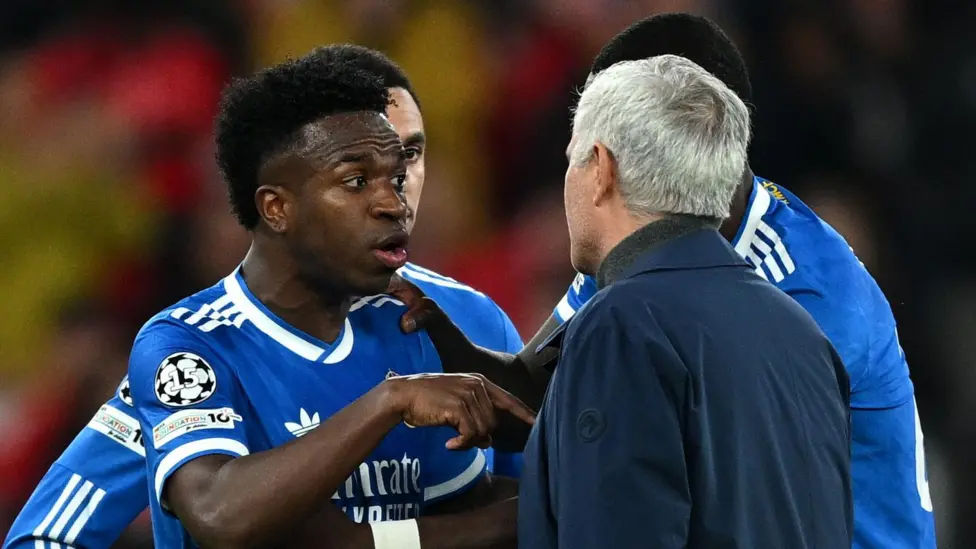
Mourinho’s reaction to the situation drew significant attention and criticism. He was seen speaking with Vinicius on the pitch after the altercation, but it was his comments during the post-match press conference that caused the most debate.
While expressing support for his own player, Prestianni, Mourinho suggested that Vinicius’s behavior may have contributed to the escalation of tensions. He questioned the Brazilian’s celebration, implying that it had provoked the crowd.
Mourinho stated that while Vinicius is an extraordinary talent, he believed the forward’s actions had played a role in the incident. He emphasized that he wanted to remain neutral, as both players had presented different accounts of what happened.
These remarks were widely criticized by pundits and fans, many of whom felt that Mourinho’s comments shifted focus away from the seriousness of the racism allegations. Critics argued that suggesting the victim had provoked the situation was inappropriate and undermined efforts to combat discrimination in football.
Mourinho also defended Benfica’s reputation, referencing the club’s legendary figure Eusebio as evidence that the club is not racist. However, this argument did little to quell the backlash against him.
Several prominent figures in football voiced their disapproval. Former Real Madrid midfielder Clarence Seedorf criticized Mourinho’s stance, stating that there should never be any justification for racist behavior, regardless of circumstances. Similarly, former Arsenal forward Theo Walcott described Mourinho’s comments as a poor judgment, suggesting that it would have been better for him to avoid speaking publicly on the matter.
Vinicius himself responded by posting a statement on social media, condemning racism and expressing frustration over how such incidents continue to occur. He described those who engage in racist behavior as cowardly and emphasized that such experiences are unfortunately not new to him.
Looking ahead, questions remain about Vinicius’s long-term future at Real Madrid. Although his current contract runs until 2027, negotiations over a renewal have reportedly slowed. One of the key issues is believed to be his desire for recognition as the club’s highest-paid player, particularly following his consistent performances over recent years.
The arrival of Kylian Mbappe has also added complexity to the situation, as it has altered the team’s hierarchy and financial structure. Real Madrid, under Perez’s leadership, has traditionally maintained strict control over its wage system, making negotiations more challenging.
Despite these challenges, Vinicius has repeatedly expressed his love for the club, describing Real Madrid as his dream destination and stating his desire to remain there for many years. His commitment to the team suggests that a resolution could eventually be reached.
A strong performance at the upcoming World Cup in Brazil could further strengthen his position in contract discussions. However, the role Mourinho plays in shaping the environment around him could be equally important.
Ultimately, the relationship between Mourinho and Vinicius may prove निर्णायक in determining the player’s future. If Mourinho can establish a supportive and constructive rapport with the Brazilian forward—particularly in addressing sensitive issues such as racism—it could encourage Vinicius to commit his long-term future to the club.
As expectations continue to rise both on and off the pitch, the upcoming season is likely to be a defining period for both Mourinho and Vinicius. Their ability to work together effectively could shape not only Real Madrid’s success but also the broader narrative of Mourinho’s return to one of football’s most iconic clubs.