
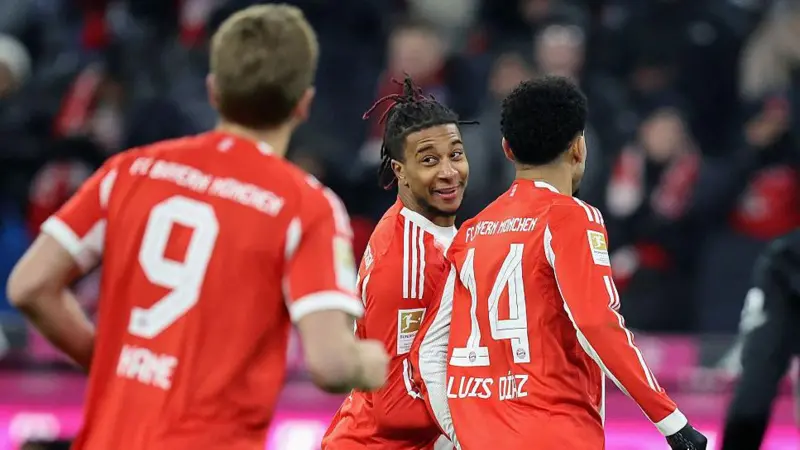
When attackers like Harry Kane, Michael Olise, and Luis Diaz charge toward goal, defenders often know the outcome before it happens. Their precision, composure, and attacking intelligence have made them one of the most dangerous forward trios in modern football. Clubs such as Atalanta, Real Madrid, and Paris Saint-Germain have all experienced firsthand just how devastating this Bayern Munich trio can be.
Since forming their partnership at the beginning of the season in August, the three forwards have combined to score over 100 goals in all competitions. This remarkable milestone places them among an elite group, as they are only the fifth trio in the 21st century to achieve such a feat. Their incredible output has played a major role in Bayern Munich securing the Bundesliga title and now aiming for further success in both the DFB Pokal and the UEFA Champions League.
As Bayern prepare for a crucial Champions League semi-final second leg against PSG, trailing 5-4 after a thrilling first encounter, attention has turned to how this trio compares with some of the greatest attacking combinations in football history.
The concept of a three-man attacking line is not new. However, its modern resurgence can largely be attributed to the revolutionary work of Pep Guardiola during his time at Barcelona between 2008 and 2012. Guardiola’s system emphasized fluid movement, positional interchange, and a balance between midfield control and attacking dynamism.
At the heart of that system was Lionel Messi, who often operated centrally but frequently dropped deeper into midfield. This movement disrupted defensive structures, creating space for teammates and allowing Barcelona to dominate possession and dictate matches. The approach proved incredibly successful, with Barcelona winning multiple major trophies, including two Champions League titles.
Following Barcelona’s success, many top European clubs adopted similar tactical setups. Teams like Real Madrid and PSG began to rely on dynamic front threes to maximize attacking output and flexibility.
In the English Premier League, one of the closest comparisons to Guardiola’s Barcelona system came through Liverpool under Jurgen Klopp. Their iconic trio of Sadio Mane, Roberto Firmino, and Mohamed Salah became one of the most celebrated attacking units in English football history.
Firmino played a unique role as a central forward who often dropped into midfield, linking play and creating opportunities for Mane and Salah to exploit spaces behind defenses. This fluid system helped Liverpool secure major honors, including the Champions League and the Premier League.
When discussing the most prolific front threes, one cannot overlook Barcelona’s legendary combination of Luis Suarez, Neymar, and Lionel Messi. Widely regarded as one of the greatest attacking trios ever assembled, they achieved extraordinary goal-scoring numbers.
Between the 2014-15 and 2016-17 seasons, the trio scored 122, 131, and 111 goals respectively—figures that set a benchmark for attacking excellence. Their chemistry, creativity, and clinical finishing made them virtually unstoppable during their peak years.
Another iconic trio was formed at Real Madrid, featuring Gareth Bale, Cristiano Ronaldo, and Karim Benzema. During the 2014-15 season, they collectively scored 100 goals, showcasing their ability to dominate both domestically and in European competitions.
Despite these legendary examples, achieving a combined 100 goals in a single season remains extremely rare. Since the 2013-14 campaign, it has only been accomplished five times, highlighting just how exceptional Bayern Munich’s current trio truly is.
This season, Bayern’s attacking unit has not only matched that milestone but also set a historic record for German football. For the first time ever, a Bundesliga club has produced a front three that scored over 100 goals in a single season. This achievement surpasses the previous record set in the 1972-73 season by Bayern legends Gerd Muller, Uli Hoeness, and Willi Hoffmann, who managed 99 goals.
The current trio’s success lies in their well-defined roles and tactical discipline. Diaz operates primarily on the left wing, using his pace and dribbling ability to stretch defenses. Olise plays on the right, offering creativity and precise delivery, while Kane leads the line as a traditional striker, combining clinical finishing with intelligent movement.
This structured approach allows Bayern to maintain consistent attacking output across matches. Each player understands their role clearly, contributing to a balanced and effective system.
In contrast, PSG’s current attacking setup focuses more on fluidity and unpredictability. Under the guidance of Luis Enrique, the French side relies on players who frequently interchange positions and create chaos for opposing defenses.
PSG’s modern attacking trio includes Ousmane Dembele, Desire Doue, and Khvicha Kvaratskhelia. While they may not match Bayern’s goal-scoring numbers, their ability to disrupt defensive structures and create scoring opportunities is highly effective.
In previous seasons, PSG’s top scorers included Dembele, Goncalo Ramos, and Bradley Barcola, who combined for 72 goals. Meanwhile, Doue, Kvaratskhelia, and Dembele contributed 55 goals in another campaign. This season, their output has been lower, with the trio scoring 48 goals compared to Bayern’s impressive 101.
The difference between the two teams lies in their tactical philosophies. Bayern relies on structure and consistency, while PSG emphasizes creativity and adaptability. Both approaches have their strengths, but Bayern’s efficiency in front of goal has given them a clear edge in terms of numbers.
As the Champions League semi-final reaches its निर्णायक stage, all eyes will be on these attacking units. Bayern’s trio will aim to overturn the deficit and secure a place in the final, while PSG’s dynamic forwards will look to maintain their advantage.
Regardless of the outcome, Bayern Munich’s front three has already secured its place among the elite attacking combinations in modern football. Their ability to deliver consistently at the highest level demonstrates the importance of teamwork, tactical understanding, and individual brilliance.
For more sports news and updates, visit: https://netsports247.com