
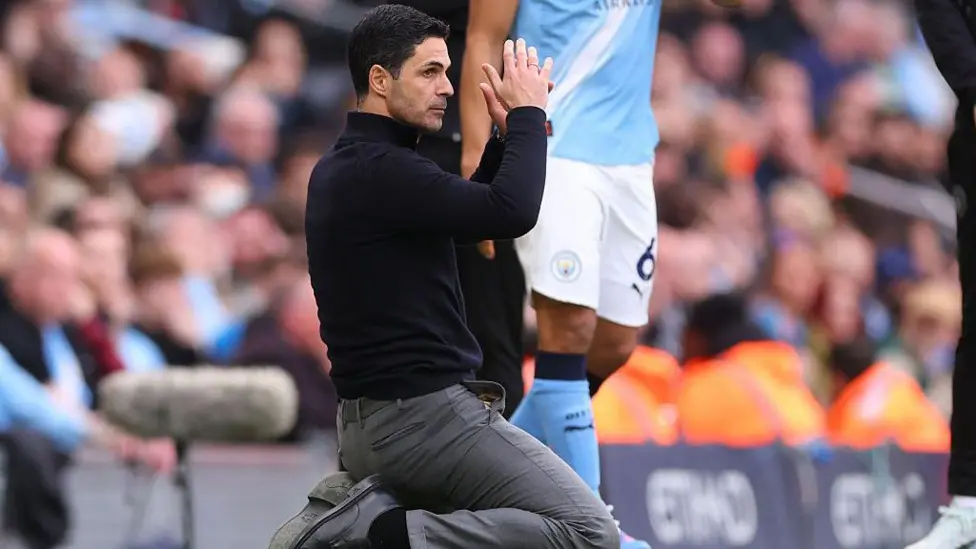
The image of Mikel Arteta dropping to his knees in frustration after Kai Havertz missed a golden stoppage-time opportunity perfectly summed up Arsenal’s painful defeat to Manchester City. For many supporters, that moment captured the essence of the match—and perhaps even their season—where missed chances and the absence of a clinical finisher proved costly once again.
In what many had labelled a decisive clash in the Premier League title race, Manchester City edged Arsenal 2-1, tightening the gap at the top and shifting momentum firmly in their favour. Much like their previous encounter in the Carabao Cup final, City once again demonstrated their ability to deliver in crucial moments, underlining the difference that a ruthless edge can make at the highest level.
Erling Haaland was the decisive figure for Pep Guardiola’s side. In the 65th minute, the Norwegian striker showcased his strength and composure by holding off Gabriel Magalhães before calmly slotting home the winning goal. It was a moment that highlighted exactly what Arsenal have been missing—a forward capable of consistently converting opportunities under pressure.
To their credit, Arsenal did not play poorly. In fact, they matched City in many areas of the game and created several promising chances. However, football often comes down to fine margins, and both managers acknowledged that the difference lay in the decisive moments inside the penalty areas. For Arsenal, those moments did not go their way.
Arteta’s side approached the game with attacking intent. The inclusion of Eberechi Eze alongside Martin Ødegaard was a tactical decision aimed at controlling possession and creating more attacking opportunities. While the plan showed promise, it ultimately fell short due to a lack of clinical finishing.
Kai Havertz, leading the line in place of summer signing Viktor Gyökeres, managed to score Arsenal’s equaliser. His goal came in unusual fashion, as he blocked a clearance from City goalkeeper Gianluigi Donnarumma, with the ball deflecting into the net. While the goal brought Arsenal back into the game, it was his missed opportunities that would later define his performance.
In the second half, with the match finely balanced, Havertz found himself through on goal but failed to beat Donnarumma. Later, in the dying moments of the game, he missed a header from close range that could have secured a dramatic equaliser. It was this moment that left Arteta visibly devastated on the touchline.
Arsenal also came close through other avenues. Eze struck the post with a powerful effort from distance, while Gabriel’s header from a set-piece also rattled the woodwork. Despite these chances, the Gunners were unable to find the finishing touch required to get something from the game.
The result has reignited concerns about Arsenal’s attacking options. Despite investing heavily in Viktor Gyökeres, questions remain about whether he is the right fit for the team. Although he has contributed goals across competitions, his overall impact, particularly against top-level opposition, has been inconsistent.
Arteta acknowledged the challenge of improving his team’s finishing. He pointed out that factors such as luck, timing, and execution all play a role in determining whether chances are converted. However, he also recognized that these are the moments that ultimately decide matches and, by extension, title races.
One of the most striking aspects of Arsenal’s campaign is the absence of a standout forward. Historically, title-winning teams have relied on prolific goal scorers—players capable of delivering consistently throughout the season. Manchester City have Haaland, while previous champions have boasted the likes of Mohamed Salah, Sergio Agüero, and Didier Drogba.
In contrast, Arsenal’s attacking options have struggled to produce similar levels of output. Havertz’s goal in this match was his first of the season, while Leandro Trossard has endured a lengthy goal drought. Noni Madueke and Eze have contributed sporadically, but not at the level required to sustain a title challenge.
The absence of Bukayo Saka due to injury has also been a significant blow. Normally one of Arsenal’s most reliable performers, his reduced availability and output this season have further exposed the team’s lack of attacking depth.
Throughout the campaign, Arsenal have been praised for their defensive solidity and effectiveness from set-pieces. However, this reliance has also drawn criticism. While set-pieces can provide valuable goals, they are not always sufficient to break down well-organized opponents in open play.
Statistically, Arsenal’s struggles in open play are evident. Their expected goals figure from open play ranks below several of their rivals, including Manchester City and Chelsea. This suggests a broader issue in chance creation and attacking fluidity.
Former Arsenal defender Gaël Clichy highlighted the potential downside of relying too heavily on set-pieces. While effective in the short term, it can lead to a more cautious approach, where the focus shifts from creating dynamic attacking opportunities to simply avoiding mistakes.
Clichy also suggested that Arsenal’s attacking players could benefit from greater آزادی and creative freedom. With the talent at their disposal, a more expressive style of play could unlock their potential and make them more dangerous in open play.
Despite the defeat, Arsenal’s title hopes are not over. They still hold a narrow lead at the top of the table, and with several matches remaining, the outcome remains in their hands. Arteta remains optimistic, emphasizing the belief within the squad and their determination to continue fighting.
The players themselves are reportedly confident that they can still secure the title. However, with Manchester City gaining momentum and closing the gap, the pressure is mounting.
Goal difference could also play a crucial role in determining the final standings. This adds further importance to Arsenal’s need to not only win matches but to do so convincingly.
As the season enters its निर्णायक phase, Arteta faces a critical challenge. Finding a way to unlock his team’s attacking potential and instill a killer instinct in front of goal could be the difference between success and disappointment.
The defeat to Manchester City serves as a reminder of the fine margins that define elite football. Arsenal have shown they can compete with the best, but without consistent finishing, their title ambitions may fall short.
Ultimately, this match may be remembered not just for City’s victory, but for the opportunities Arsenal failed to take. For Arteta and his players, the task now is to respond—to learn from these moments and ensure they do not define their season.
For more latest football news and updates, visit:
👉 https://netsports247.com/