

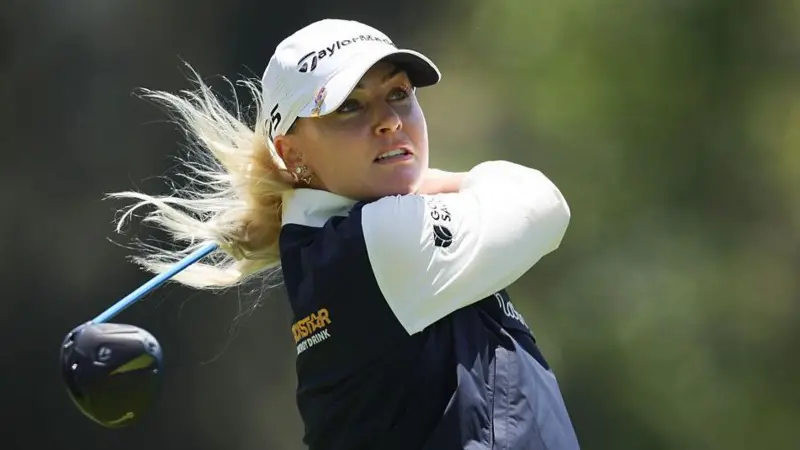
Aggressive, fearless play is not typically the blueprint for success at the US Women’s Open, a tournament renowned for its demanding conditions and emphasis on precision. Yet at the iconic Riviera Country Club, Charley Hull came remarkably close to proving that an attacking mindset can still deliver extraordinary results at the highest level.
The English golfer continues to edge closer to securing her first major championship victory, and her performance in California suggested that breakthrough moment may not be far away. Ultimately, however, it was the exceptional quality of world number one Nelly Korda that denied Hull a historic triumph.
The tournament unfolded as one of the most thrilling editions of the US Women’s Open in recent years. Hull produced a stunning weekend surge, equaling a long-standing championship record while finishing just a single shot behind Korda’s winning score. It was a dramatic conclusion that highlighted both Hull’s immense talent and her ongoing quest for a major title.
For followers of Hull’s career, the pattern felt familiar. She has often struggled to make fast starts in major tournaments, only to produce remarkable comebacks in the later rounds. This trend was evident once again at Riviera, echoing her performance at Pebble Beach three years earlier, where she finished as a joint runner-up to Allisen Corpuz.
Back then, Hull embraced a bold mindset, famously declaring that timid players do not achieve great rewards. That approach helped her climb the leaderboard, though she ultimately fell short by three shots. At Riviera, her mentality was similarly aggressive, though expressed in more direct and less polished language, reflecting her determination to seize the moment.
Her strategy was simple: attack whenever possible. Hull explained that while she tends to adopt a more cautious approach during the opening rounds, focusing on maintaining composure and avoiding mistakes, the final stages of a tournament allow her to play with freedom. With nothing to lose, she thrives on taking risks and embracing an attacking style that mirrors how she plays casually at home.
This mindset paid off spectacularly over the weekend. Hull followed a brilliant third-round score of 65—the lowest round recorded during the tournament—with an equally impressive final-round 67. Her closing round began in explosive fashion, featuring an eagle and a birdie within the first three holes, immediately putting pressure on her competitors.
A key factor in Hull’s resurgence was her improved performance on the greens. During the opening rounds, putting had been a significant weakness, with a total of 63 putts across the first two days. However, she made substantial adjustments and reduced that number by ten strokes over the final two rounds, demonstrating her ability to adapt and refine her game under pressure.
Even so, there were moments that proved costly. Missed opportunities on the ninth, twelfth, and fourteenth holes in the final round prevented her from fully capitalizing on her momentum. Despite these setbacks, Hull’s overall performance showcased the qualities of a future major champion.
One of the most defining moments came on the closing hole. Facing a crucial ten-foot putt to take the clubhouse lead, Hull displayed remarkable composure. With confidence and precision, she sank the putt, briefly putting herself in a position where victory seemed possible.
However, Nelly Korda had other plans. The American star, who has been in exceptional form, delivered a decisive performance when it mattered most. Her brilliant recovery for birdie on the par-five seventeenth hole ensured that she maintained control heading into the final hole.
Korda then faced a tense moment on the eighteenth green, needing only a par to secure the title. Her short putt circled the edge of the hole before finally dropping in, a dramatic finish that she later described as resembling an “ice cream swirl.” It was a nerve-wracking conclusion, but one that ultimately confirmed her status as the champion.
Hull was joined in second place by Gabby Lopez, with both players finishing seven under par. For Hull, it marked her fifth runner-up finish in major championships, further emphasizing both her consistency and her frustration at narrowly missing out on victory.
Despite the disappointment, there are strong indications that Hull’s breakthrough is imminent. Her recent record speaks volumes, with two runner-up finishes in her last three majors and eight top-20 finishes in her previous eleven appearances. These results underline her ability to compete at the highest level consistently.
Hull herself has expressed a deep love for major tournaments, admitting that they provide a level of motivation she sometimes struggles to find in regular events. The intensity, challenge, and prestige of majors bring out the best in her, allowing her to produce her most exciting and dynamic golf.
While Hull’s aggressive style is a key strength, there are lessons she can take from Korda’s approach. The world number one demonstrated the importance of patience, discipline, and strategic decision-making. Rather than attacking every opportunity, Korda carefully selected moments to be aggressive while maintaining control throughout the round.
Working closely with her caddie, Jason McDede, Korda focused on taking each shot individually, avoiding distractions such as leaderboard pressure. This measured approach allowed her to stay composed and execute under pressure, ultimately securing her fourth major title.
Korda’s 2026 season has been nothing short of remarkable. With multiple victories and several runner-up finishes, she has established herself as the dominant force in women’s golf. Her ability to handle pressure and deliver in crucial moments sets her apart from her peers.
Even Korda, however, faced challenges during the tournament. A difficult opening round prompted a subtle adjustment to her grip, suggested by her sister Jessica. This change proved effective, helping her regain control and improve her driving accuracy.
Putting, often considered a weakness in her game, became a strength during the tournament. Korda gained significant strokes on the greens compared to the rest of the field and led the statistics in scrambling, highlighting her all-around excellence.
The US Women’s Open at Riviera tested every aspect of a golfer’s skill set. The course conditions made it difficult to approach the greens effectively, while the firm and sloping surfaces demanded precision and creativity. In such a demanding environment, Korda’s composure and adaptability proved decisive.
For Hull, the experience offers valuable lessons. While her fearless approach can produce spectacular results, incorporating elements of patience and strategy could help her convert near-misses into victories. By blending aggression with control, she may finally achieve the major success that has so far eluded her.
As for Korda, this victory represents another milestone in an already outstanding career. It fulfills a long-held dream and reinforces her position as one of the leading figures in the sport. Her journey serves as both inspiration and a benchmark for competitors like Hull.
Looking ahead, it seems only a matter of time before Hull joins the ranks of major champions. Her talent, determination, and growing experience suggest that her moment will come sooner rather than later. When it does, it will be the culmination of years of perseverance and near-misses.
For now, the story of Riviera is one of brilliance, resilience, and the fine margins that define elite sport. It is also a reminder that in golf, as in life, success often comes to those who learn not only from victory but also from the lessons of defeat.
For more sports updates and in-depth coverage, visit: https://netsports247.com